


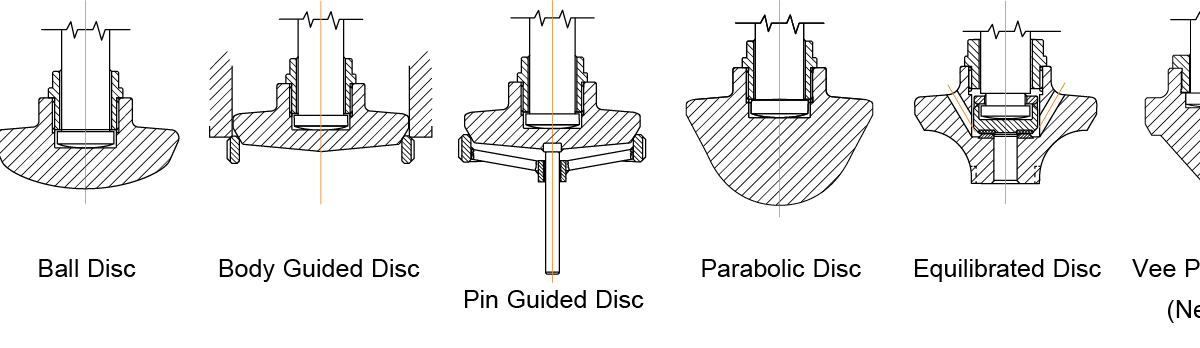
Types of Disc Designs in Globe Valves
Globe valves are widely used in industrial piping systems to regulate fluid flow, control pressure drop, and provide reliable shutoff. One of the most important components of a globe valve is its disc design, which directly affects flow control accuracy, throttling performance, pressure drop, and service life.
Different globe valve disc designs are developed for different operating conditions, including general-purpose flow regulation, high-pressure service, high-temperature applications, and systems requiring precise flow control.
For engineers, procurement professionals, and industrial valve buyers, understanding the main types of globe valve discs is essential for selecting the right valve for a specific application.
1. What Is a Globe Valve Disc?
A globe valve disc is the movable closure element that works with the valve seat to regulate or stop fluid flow. When the handwheel or actuator moves the stem, the disc moves toward or away from the seat.
Unlike a gate valve, which is primarily designed for fully open or fully closed operation, a globe valve is particularly suitable for flow regulation and throttling.
The disc design determines how fluid passes through the valve, how the pressure drop is distributed, and how the valve responds to changes in stem position.
2. What Are the Main Types of Globe Valve Disc Designs?
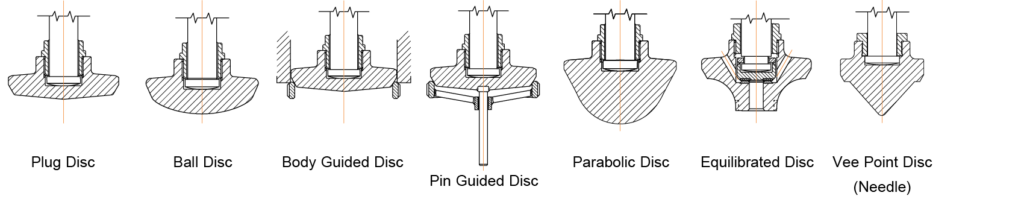
The main globe valve disc designs include the following types.
<image-placeholder>
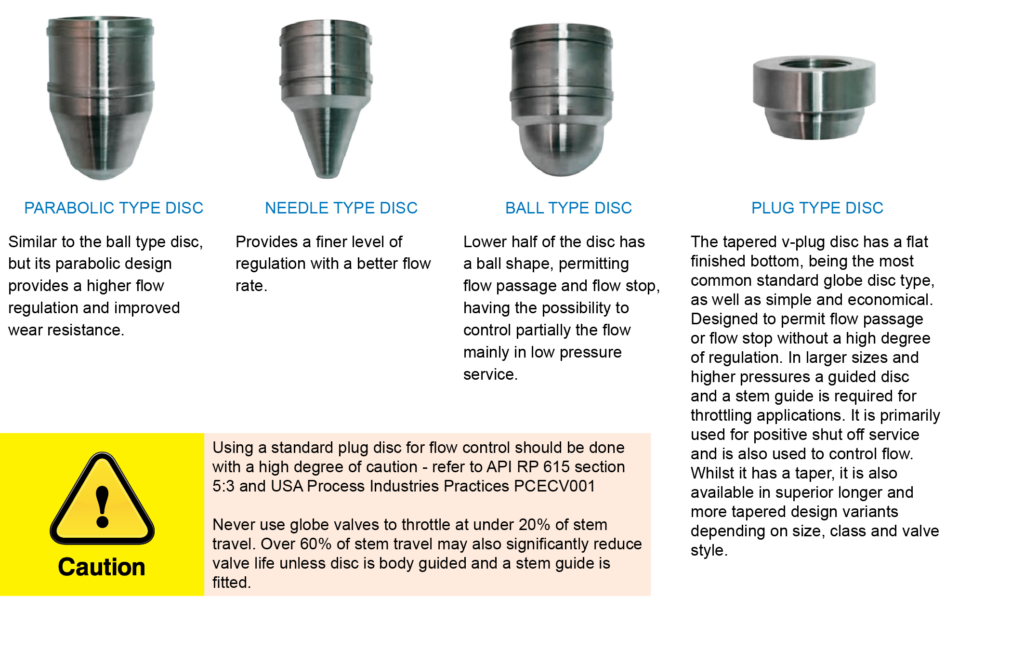
1. Flat Disc (Plug-Type Disc)
A flat or conventional plug-type disc uses a relatively simple closure surface that contacts the valve seat to shut off the flow.
Key characteristics:
- Simple and robust construction.
- Suitable for general industrial flow control.
- Can provide reliable shutoff when the disc and seat are properly matched.
- Available in different seating configurations depending on the valve design.
Typical applications: General industrial pipelines, water systems, and utility services.
The actual flow-control characteristics depend on the disc profile, seat geometry, and valve opening.
2. Needle-Type Disc
A needle-type disc features a long, narrow, tapered profile that allows fine adjustments in the opening between the disc and seat.
Key characteristics:
- Provides fine flow adjustment at small openings.
- Suitable for applications requiring precise control of relatively low flow rates.
- Allows sensitive adjustment of flow through the valve.
Typical applications: Instrumentation-related services, small-flow systems, and certain process-control applications.
Needle-type designs are more commonly associated with smaller valves. They are not generally the first choice for large-diameter, high-flow pipelines.
3. Parabolic Disc
A parabolic disc has a contoured profile designed to provide more controlled changes in flow as the valve opens.
Key characteristics:
- Can provide improved throttling characteristics.
- Helps achieve a more predictable relationship between valve travel and flow.
- Can be selected for process applications requiring stable flow regulation.
Typical applications: Process pipelines, industrial flow-control systems, and applications requiring modulating operation.
The actual flow characteristic depends on the complete valve geometry and operating conditions, not the disc profile alone.
4. V-Port or V-Profile Disc
A V-profile closure element uses a shaped opening or contoured geometry to influence the flow characteristic. The exact configuration varies by manufacturer and valve design.
Key characteristics:
- Can provide more controlled flow regulation.
- May improve adjustment sensitivity over a selected operating range.
- Requires careful consideration of erosion, cavitation, and fluid conditions.
Typical applications: Specialized throttling services and process systems requiring a defined flow characteristic.
A V-port design is not universal across conventional globe valves. Buyers should verify whether the manufacturer offers this configuration for the required model.
5. Composition Disc (Soft-Seated Disc)
A composition disc uses a resilient, non-metallic seating element or insert, depending on the design. This can improve sealing performance under suitable operating conditions.
Key characteristics:
- Can provide tight shutoff in compatible services.
- May reduce leakage across the seating interface.
- Has temperature, pressure, and chemical-compatibility limitations determined by the seating material.
Typical applications: Selected water, utility, and low-to-moderate-temperature services where soft seating is appropriate.
The suitability of a soft-seated disc depends on the fluid, operating temperature, pressure, and required leakage class.
6. Metal-Seated Disc
A metal-seated globe valve uses metal seating surfaces, typically with the disc and seat made from compatible base materials or hard-facing alloys.
Key characteristics:
- Suitable for many demanding industrial operating conditions.
- Can offer good resistance to elevated temperatures when properly designed.
- Allows material selection tailored to wear, erosion, and process-fluid requirements.
Typical applications: Oil and gas, petrochemical processing, power generation, and other industrial services.
Metal seating does not automatically guarantee zero leakage. Actual shutoff performance depends on the design, surface finish, material pairing, manufacturing quality, and applicable test requirements.
3. Comparison of Globe Valve Disc Designs
| Disc Design | Main Advantage | Typical Application |
|---|---|---|
| Flat or plug-type | Simple, versatile construction | Общие промышленные услуги |
| Needle-type | Fine adjustment at small openings | Low-flow control |
| Parabolic | Controlled throttling characteristics | Process flow regulation |
| V-profile | Tailored flow-control behavior | Specialized throttling service |
| Composition or soft-seated | Tight shutoff in suitable conditions | Compatible utility services |
| Metal-seated | Broad industrial temperature and service options | Oil, gas, chemical, and power industries |
Important: These categories are not all mutually exclusive. For example, a globe valve can have a parabolic-profile disc with metal seating, or a plug-type disc with a soft seating element. Actual design terminology varies among manufacturers.
4. How to Choose the Right Globe Valve Disc Design
Selecting the correct disc design requires evaluating the operating conditions and control objectives.
Operating Pressure and Temperature
High-pressure and high-temperature applications require a disc, seat, body, and trim combination designed for the specified service conditions.
Flow Regulation Requirements
If precise throttling is required, consider the required flow range, valve travel, controllability, and the valve’s inherent flow characteristic.
Fluid Properties
The medium’s viscosity, corrosiveness, suspended solids, and tendency to cause erosion or cavitation can influence disc geometry and material selection.
Leakage Requirements
Determine whether the application requires general shutoff or a specified seat leakage performance. Soft-seated and metal-seated configurations have different limitations.
Совместимость материалов
Disc and seat materials should be selected based on the fluid, temperature, wear conditions, and applicable engineering standards.
Maintenance and Service Life
Consider the availability of replacement trim, inspection requirements, operating frequency, and expected maintenance intervals.
5. Why Disc Design Matters for Industrial Globe Valves
The correct disc design helps engineers balance flow regulation, shutoff performance, durability, and operating efficiency.
An unsuitable disc can contribute to unstable flow, excessive noise, erosion, cavitation damage, or premature seat wear. Conversely, a well-matched disc and seat combination can improve controllability and help reduce maintenance costs over the valve’s service life.
For this reason, valve selection should consider the complete assembly—including the body, seat, disc, stem, actuator, and flow passage—rather than relying on disc shape alone.
6. Oudian Valve: Globe Valve Solutions for Industrial Applications
Oudian Valve supplies industrial valves for a range of pipeline and process applications. For customers selecting a globe valve, the appropriate disc and trim configuration should be determined by the required pressure class, temperature, process medium, flow-control objective, and shutoff requirements.
When requesting a globe valve from Oudian, buyers should specify:
- Nominal size and pressure class.
- Body, disc, and seat materials.
- Operating pressure and temperature.
- Fluid type and required flow rate.
- Throttling or isolation requirements.
- Applicable design and testing standards.
Visit the official website to explore Oudian Valve’s industrial valve range:
Confirm the available disc designs and exact product configurations directly with Oudian Valve before placing an order.
7. Frequently Asked Questions
Q1: What is the most common disc design in a globe valve?
Conventional plug-type or contoured discs are widely used in globe valves. The appropriate design depends on whether the primary objective is general flow regulation, precise throttling, or reliable shutoff.
Q2: Which globe valve disc is best for throttling?
A contoured or parabolic disc may be suitable for throttling, depending on the required flow characteristic. The final selection should also consider pressure drop, cavitation risk, fluid properties, and operating range.
Q3: What is the difference between a metal-seated and a soft-seated globe valve?
A metal-seated valve uses metal contact surfaces and is commonly selected for demanding industrial conditions. A soft-seated valve uses a resilient seating material to improve shutoff in compatible applications, but its temperature and chemical resistance may be more limited.
Q4: Can a globe valve be used for continuous flow control?
Yes. Globe valves are commonly used for throttling and modulating service when properly selected. Severe throttling conditions may require a specialized control valve design.
Q5: Does the disc design affect pressure drop?
Yes. Disc shape, seat geometry, valve opening, and internal flow passages influence pressure drop and flow capacity. The actual performance should be evaluated using manufacturer flow coefficients and operating data.
Q6: How do I select a globe valve disc for high-temperature service?
Confirm the design temperature, pressure-temperature rating, body and trim materials, seating arrangement, and expected thermal effects. The complete valve must be suitable for the specified operating conditions.
Заключение
The main types of globe valve disc designs include flat or plug-type discs, needle-type discs, parabolic profiles, specialized V-profile designs, composition discs, and metal-seated configurations.
Each design offers different benefits for flow control, shutoff, wear resistance, and operating conditions. The best choice depends on the application rather than the disc shape alone.
For industrial buyers, understanding these differences helps improve valve selection, reduce operational risks, and achieve more reliable pipeline performance. Contact Oudian Valve to discuss the appropriate globe valve configuration for your project.



