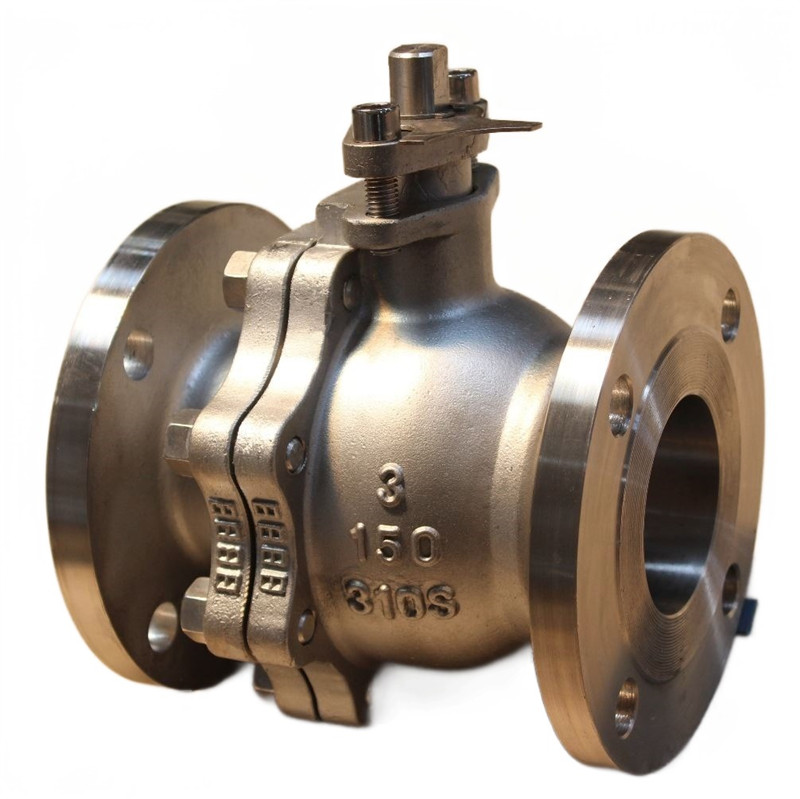


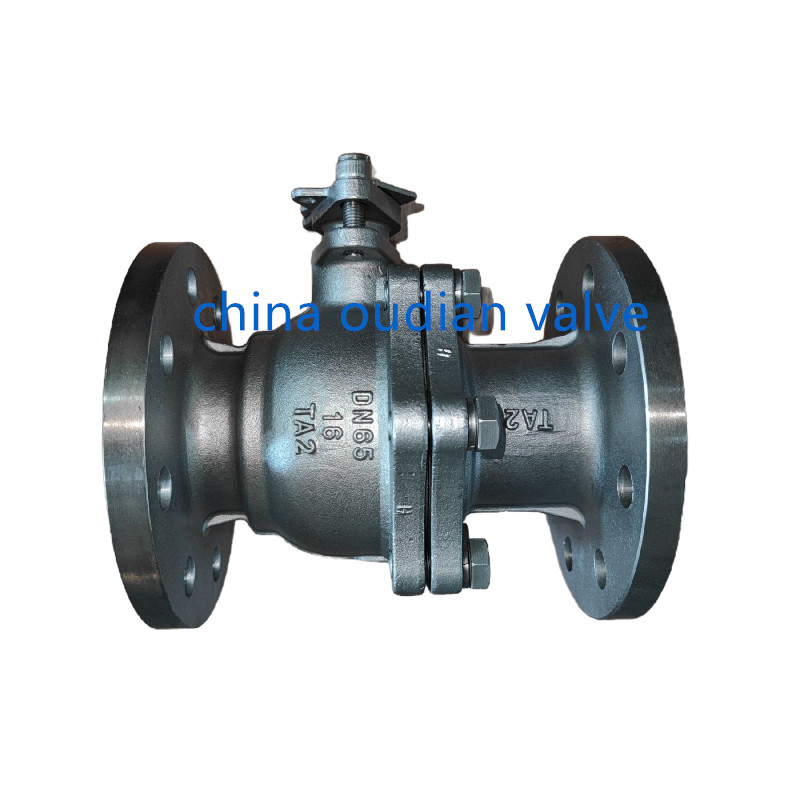
TA2 Ball Valve,PN16,DN65,RF End
Basic Definition
- Standard Basis: Complies with DIN series standards (e.g., DIN 3202 for structure length, DIN 2999 for threads, DIN EN 1092-1 for flanges, DIN EN 558 for face-to-face dimensions).
- Working Principle: A perforated ball rotates 90° to open/close or regulate flow; simple structure, fast operation, good sealing.
- Main Specifications:
- Nominal Size: DN15~DN600 (½”~24″)
- Pressure Rating: PN10/16/25/40/63/100/160
- Connection: Threaded, flanged, welded, wafer-type
- Body Material: WCB carbon steel, SS304/CF8, SS316/CF8M stainless steel, alloy steel, bronze
- Seal: Soft-seated (PTFE, up to ~200°C) / Metal-seated (high temperature ≥400°C)
Key Features
- High Sealing: Bidirectional tight shut-off, low leakage; optional fire-safe & anti-static design.
- Low Resistance: Full bore design, minimal pressure loss, suitable for cleaning/pigging lines.
- Durable: Blowout-proof stem, anti-corrosion materials, long service life.
- Easy Automation: ISO 5211 mounting pad, compatible with manual/gear/pneumatic/electric actuators.
- Certified: Meets EN 12266, CE, PED, ISO 9001; 3.1 material certification available.
TA2 Ball Valve,PN16,DN65,RF End
Valve Description:
Valve Type: Floating Ball Valve
Body Material: Titanium TA2.
Nominal Diameter: DN25
Pressure Rating: PN16
End Connection: RF Flange
Working Temperature: -29℃~+200℃.
Operation: Lever.
Application fields and product features of hot isostatic pressing titanium ball valve
As a high-performance valve, hot isostatic pressing titanium ball valve has been widely used in many fields due to its unique material and structural design. Its main application areas include petroleum, chemical industry, salt production, chlor-alkali, soda ash, urea and seawater desalination. The hot isostatic pressing titanium ball valve adopts a top-loading structure, which can reduce the connecting bolts of the valve body itself under high pressure and large diameter conditions, enhance the reliability of the valve, and overcome the influence of the system’s deadweight on the normal operation of the valve.
The characteristics of hot isostatic pressing titanium ball valve are its excellent corrosion resistance, high strength and low density. Titanium is a highly chemically active metal with a good affinity for oxygen. When it comes into contact with the atmosphere or any oxygen-containing medium, it can immediately form a strong and tight passive oxide film on its surface. This oxide film is very stable and difficult to dissolve. Even if it is mechanically damaged, it will quickly regenerate as long as there is oxygen. Therefore, titanium ball valves perform well in a variety of corrosive media, especially suitable for equipment in chlor-alkali, soda ash, pharmaceuticals, urea and petrochemical industries. In addition, titanium ball valves also have two forms: soft seal and metal hard seal, which can solve the corrosion problems that are difficult to solve with valves such as stainless steel, copper alloy, aluminum or plastic in industrial pipelines.
Introduction and application of hot isostatic pressing technology
Hot isostatic pressing (HIP) is a special heat treatment process for metal or ceramic materials, and is an important means of preparing high-performance materials. This process densifies the internal structure of the material through the combined action of high temperature and high pressure, and all pores and defects disappear to form a uniform and dense whole, greatly improving the wear resistance, corrosion resistance and mechanical properties of the material. Hot isostatic pressing technology can be applied to powder metallurgy forming or densification of formed castings (such as loose shrinkage castings such as titanium alloys, high-temperature alloys, aluminum alloys, etc.).
The hot isostatic pressing device is mainly composed of a water-cooled pressure vessel, a heating furnace, and additional facilities such as control, safety, and manipulation. The operation process includes putting powder or powder compact into the package, vacuum sealing after removing gas, placing it in a pressure vessel, pumping inert gas to a certain pressure, and then heating it to the required temperature to complete forming and sintering. Hot isostatic pressing technology is widely used in marine, aviation, aerospace, automotive and other fields because it combines the advantages of hot pressing and isostatic pressing, has low forming temperature, dense products and excellent performance.
In the production process of hot isostatic pressing titanium ball valve, hot isostatic pressing technology can be used to improve the density and mechanical properties of titanium materials, thereby improving the overall quality and reliability of the valve. Through hot isostatic pressing treatment, the wear resistance, corrosion resistance and fatigue life of titanium ball valves are significantly enhanced, making them more durable under various harsh working conditions.
Material characteristics and chemical element content of titanium materials
Titanium is a metal with excellent properties. It is light, hard, corrosion-resistant and has good biocompatibility. The density of titanium is about 4.5g/cm³, which is only 57% of that of steel, but its specific strength (ratio of strength to density) is very high, about 2 times the hardness of ordinary steel and about 6 times that of aluminum. Titanium has excellent corrosion resistance and can remain corrosion-free in seawater for 20 to 50 years, and can even resist the erosion of aqua regia.
Among the chemical composition of titanium materials, industrial pure titanium such as TA1 has a titanium content of more than 99.5%, and the impurity content is very low, such as trace elements such as iron, hydrogen, nitrogen, and carbon. These impurities have a subtle effect on the performance of titanium materials. For example, industrial pure titanium such as TA2 and TA3 has improved strength and hardness compared with TA1. Titanium alloys such as TC4 (Ti-6Al-4V) have higher strength and better high temperature resistance, and are widely used in aerospace, medical and other fields.
In summary, hot isostatic pressing technology titanium ball valves have been widely used in many fields due to their excellent corrosion resistance, high strength and low density. As an important means of preparing high-performance materials, hot isostatic pressing technology further improves the quality and reliability of titanium ball valves by improving the density and mechanical properties of titanium materials. The material characteristics and chemical element content of titanium provide a solid material basis for its application in various harsh working conditions.
Hot isostatic pressing technology titanium ball valve pressure caliber application table
We can produce TA2 titanium alloy ball valves, titanium gate valves, globe valves, check valves etc.
| Nominal pressure or pressure level | DN/NPS(mm/in) | ||||||||||||
| 15 | 20 | 25 | 32 | 40 | 50 | 65 | 80 | 100 | 125 | 150 | 200 | 250 | |
| 1/2 | 3/4 | 1 | 11/4 | 11/2 | 2 | 21/2 | 3 | 4 | 5 | 6 | 8 | 10 | |
| PN16 | √ | √ | √ | √ | √ | √ | √ | √ | √ | √ | √ | √ | |
| PN25 | √ | √ | √ | √ | √ | √ | √ | √ | √ | √ | √ | √ | |
| PN40 | √ | √ | √ | √ | √ | √ | √ | √ | √ | √ | √ | √ | |
| PN63 | √ | √ | √ | √ | √ | √ | √ | √ | √ | ||||
| PN100 | √ | √ | √ | √ | √ | √ | √ | √ | √ | ||||
| PN160 | √ | √ | √ | √ | √ | √ | √ | √ | √ | ||||
| Class150(PN20) | √ | √ | √ | √ | √ | √ | √ | √ | √ | √ | √ | √ | √ |
| Class300(PN50) | √ | √ | √ | √ | √ | √ | √ | √ | √ | √ | √ | √ | |
| Class600(PN110) | √ | √ | √ | √ | √ | √ | √ | √ | √ | ||||
| Class900(PN150) | √ | √ | √ | √ | √ | √ | |||||||
| Class1500/PN260 | √ | √ | √ | √ | √ | √ | |||||||
| JIS 10K | √ | √ | √ | √ | √ | √ | √ | √ | √ | √ | √ | √ | √ |
| JIS 20K | √ | √ | √ | √ | √ | √ | √ | √ | √ | √ | √ | √ | |
China Titanium Ball Valve Manufacturer ,OUdian Supplies Titanium Floating Ball Valve, TA2 Floating Ball Valve, DN25 Titanium Ball Valve, PN16 Titanium Floating Ball Valve.