


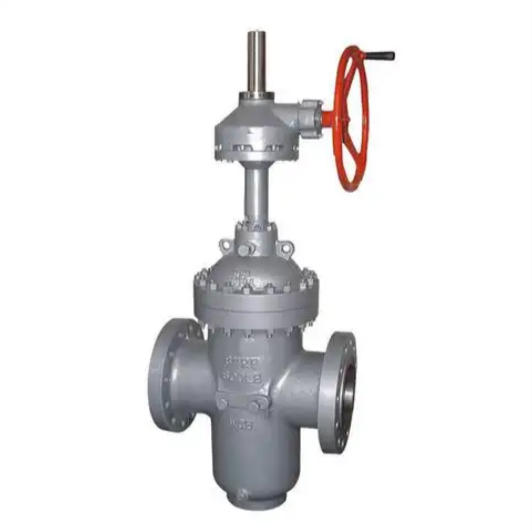
What Is a Parallel Slide Gate Valve
System designers select this design when pipelines experience extreme temperature swings or elevated fluid pressure that would otherwise cause mechanical locking in conventional valves. Construction utilizes cast or forged carbon steel, stainless steel, and specialized alloys equipped with hardened seating faces to withstand aggressive service conditions.
Operating Principle and Core Components
The operating mechanism of a parallel slide gate valve centers on two independent discs separated by internal springs and guided within a rigid body cavity. Internal disc springs maintain continuous sliding contact between the discs and the body seats during movement, wiping away particulate matter and minimizing operating friction.
When line media enters the valve body under pressure, fluid forces act directly behind the downstream disc. This upstream pressure drives the downstream disc flat against the downstream seat ring, creating an unbroken seal across the contact face. Because sealing force increases proportionally with line pressure, low-pressure sealing relies on the internal spreaders or disc springs to maintain baseline seating contact.
Flexible graphite packing and bonnet gaskets provide dependable sealing integrity under high temperatures and transient thermal cycles. Anti-static components and fire-safe materials prevent static electrical buildup and maintain structural containment during operational upsets.
Parallel Discs
Two precision-ground flat discs move perpendicular to flow without wedging against angled body walls. Internal springs sustain gentle contact with seats during disc travel.
Pressure-Assisted Sealing
Working pressure from the line drives the downstream disc firmly against its corresponding seat. The resulting contact force tightens proportionally as line pressure escalates.
Stem and Bonnet Assembly
A forged stem transmits axial movement from the actuator or handwheel through a packed stuffing box. Flexible graphite materials deliver resilient high-temperature containment.
Parallel Slide Gate Valves Compared to Wedge Gate Valves
Conventional wedge gate valves rely on mechanical torque applied through the stem to force an angled gate between matching inclined seats. When high-temperature pipelines cool during shutdowns, thermal contraction squeezes the rigid wedge tightly between the valve seats, creating thermal binding that can seize the valve or buckle the stem.
Parallel slide gate valves eliminate thermal binding because the parallel disc assembly accommodates pipe expansion and contraction without wedging. Operating torque remains significantly lower during both opening and closing cycles since operators do not have to overcome severe mechanical friction to free the closure member.
| Design Feature | Parallel Slide Valve | Wedge Gate Valve | Operational Advantage |
| Sealing Method | Line Pressure | Mechanical Wedging | Seals tightly without requiring extreme stem seating torque. |
| Thermal Binding Risk | Virtually None | Elevated Risk | Accommodates severe thermal transients without jamming closed. |
| Seat Wear Pattern | Sliding Wipe | Direct Impact | Disc motion naturally wipes particulates off the seat face. |
| Operating Energy | Low Torque | High Torque | Reduces actuator size and operator effort during cycling. |
The flat parallel seating arrangement also limits localized seat scoring from minor mechanical deflections. When pressure drops or flow reverses, the discs self-align smoothly without deforming critical sealing faces.
Industrial Applications Across High-Pressure Systems
Industrial piping networks rely on parallel slide gate valves wherever dependable on-and-off isolation of clean liquids, gases, and steam is essential. The ability to handle elevated fluid pressure and severe thermal cycling makes these units indispensable across heavy processing facilities.
In power generation stations, parallel slide gate valves handle high-pressure feedwater, main steam isolation, and boiler extraction lines. Because these systems experience severe thermal differentials between startup and standard running phases, the non-jamming parallel slide mechanism prevents costly plant shutdowns.
Continuous Thermal Processes
- Power plant boiler feed and main steam isolation circuits
- Petrochemical cracking, reforming, and hydrocarbon transfer
- District energy steam distribution headers
- High-temperature refinery process streams
Ambient & Fluid Transmission
- Mainline crude oil and natural gas transmission lines
- High-pressure industrial water treatment pumping mains
- Commercial marine and naval fluid control networks
- Industrial cooling water distribution infrastructure
Petroleum and refining facilities utilize these valves for isolation duty across process manifolds, where wide flat seating faces provide continuous containment. Water treatment plants and marine vessels rely on their durable bodies and serviceable internals for critical isolation headers.
Installation, Operation, and Maintenance Practices
Parallel slide gate valves accommodate manual handwheels, pneumatic actuators, electric motor drives, or electro-hydraulic actuators. The actuator applies torque to the stem, which draws the disc assembly through the flow path with minimal effort compared to wedge designs.
Vorteile
- Eliminates thermal binding and mechanical wedging stress.
- Maintains tight flat-surface contact across varied pressures.
- Requires lower operational torque for simplified actuation.
- Facilitates inline maintenance, seat inspection, and cleaning.
Einschränkungen
- Unsuitable for throttling or partial-flow regulating service.
- Vulnerable to seat leaks if suspended solids become trapped.
- Demands careful seating verification during initial setup.
Stem configuration represents an essential specification choice during system layout. Rising stem valves extend their threaded stem upward during opening, providing unmistakable visual confirmation of position from a distance. Non-rising stem designs keep the stem stationary while moving the internal gate assembly, making them suitable for confined shipboard spaces, subterranean vaults, and cramped pipe racks.
Routine maintenance involves checking gland packing compression, lubricating stem threads, and cycling the valve to prevent deposit buildup. Disassembly for inspection is straightforward, allowing technicians to inspect seat faces, replace internal springs, and restore sealing surfaces with standard workshop tooling.
Frequently Asked Questions
What causes a parallel slide gate valve to leak?
Debris caught between the flat seat faces or mechanical seat deformation from improper piping alignment can prevent tight contact. Inspecting seat surfaces and flushing lines before final closure prevents seal compromise.
Can a parallel slide gate valve regulate or throttle flow?
Parallel slide gate valves serve strictly as on-and-off isolation devices. Operating the valve in a partially open position causes fluid turbulence, seat erosion, and high-frequency disc chatter.
Why does a parallel slide valve avoid thermal binding?
The valve utilizes parallel discs that slide independently without an inclined wedging angle. Thermal contraction of the valve body exerts lateral force that the internal disc springs absorb without jamming the gate.
How does a rising stem differ from a non-rising stem?
A rising stem elevates through the handwheel as the valve opens, offering immediate visual indication of gate position. A non-rising stem rotates in place while the gate travels along internal threads, conserving vertical installation space.
Summary of Parallel Slide Gate Valve Performance
Parallel slide gate valves deliver reliable bidirectional isolation across demanding steam, hydrocarbon, and high-pressure fluid networks. By substituting line-pressure sealing for mechanical wedging, they eliminate thermal binding and reduce actuation effort throughout severe temperature cycles. Proper selection between rising and non-rising stems supports streamlined piping layout, durable plant operation, and simplified long-term maintenance.



