


Swing Type Check Valve vs Spring Loaded Check Valve: Technical Engineering Guide
Selecting between these non-return mechanisms depends on pipeline flow velocity, pump cycling frequency, orientation constraints, and allowable head loss. While swing check valves reduce pumping energy costs across continuous transfer lines, spring-assisted alternatives protect critical pump stations, vertical discharge headers, and sensitive process instrumentation from hydraulic shock.
Working Principles of Swing and Spring Check Valves
Non-return valves protect mechanical equipment by allowing fluid to pass in a single forward direction while arresting reverse flow automatically. The internal mechanics of swing and spring-loaded designs govern how each valve opens, remains stable during steady flow, and reseats when flow ceases.
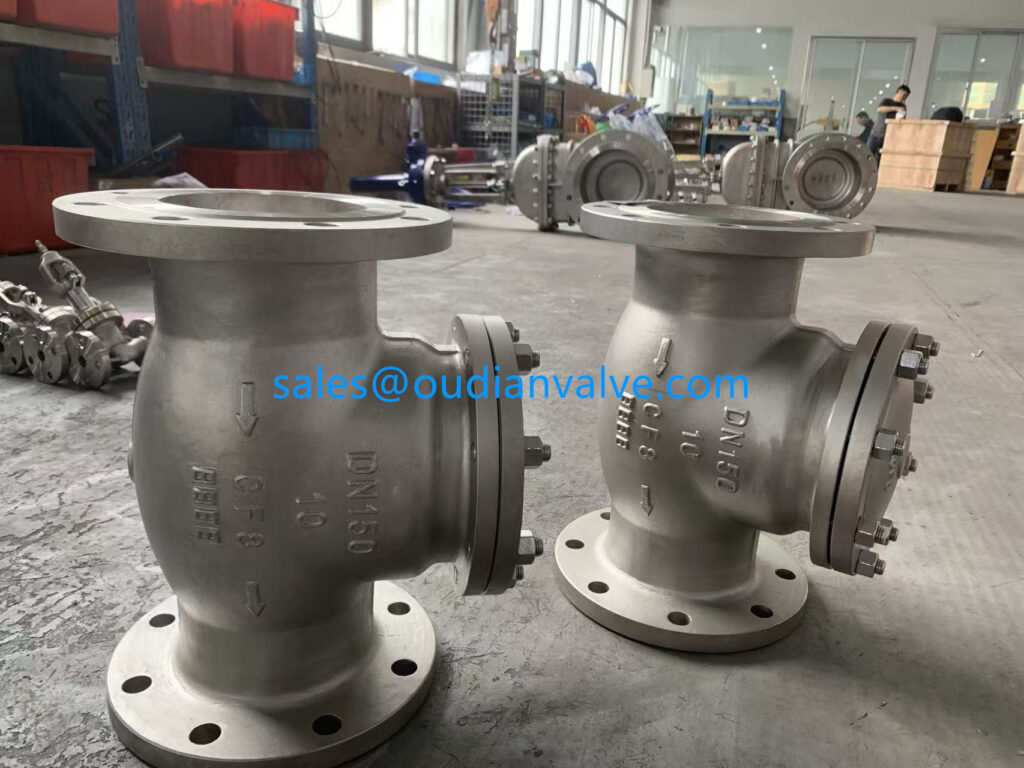
A swing check valve functions like a swinging door mounted on an overhead hinge pin. As upstream media pressure rises above line resistance, the hydrodynamic force pushes against the face of the disc, rotating it upward away from the annular seat ring. When the driving pump stops or downstream pressure equalizes, fluid momentum slows, allowing gravity and returning fluid to push the disc back down onto its seat.
A spring loaded check valve incorporates an internal helical spring that constantly biases the closing member toward the stationary valve seat. The poppet or disc remains firmly closed until forward fluid pressure overcomes both the spring force and downstream backpressure. As forward flow diminishes toward zero velocity, the spring immediately expands, seating the closing member before fluid reverse velocity can develop.
- Swing mechanisms rely entirely on forward media velocity to keep the disc lifted and gravity or reverse pressure to close.
- Spring mechanisms maintain a constant mechanical closing force that operates independently of valve body orientation.
- Flow deceleration triggers spring-assisted closure instantly, whereas swing discs travel through an arc before achieving complete seal contact.
Mechanical Construction and Seating Architecture
The internal architecture of each valve type dictates its mechanical robustness, moving parts count, and sensitivity to particulate accumulation. Differences in hinge assemblies, spring positioning, and body geometry directly affect long-term operational reliability.
Standard swing check valves feature a cast or forged body housing a free-swinging disc, an internal hinge arm, a pivot pin, and a bolted access bonnet. The disc swings through an open internal cavity, resting against an inclined or vertical metal-to-metal or resilient seat ring. Because the hinge pin must allow free rotational travel, internal clearances can be vulnerable to mechanical wear, shaft vibration, and debris accumulation around the pivot point.
Spring loaded check valves feature a guided disc, center-guided poppet, or split-disc design supported by one or more coiled or torsion springs. The spring typically surrounds a central guide stem or sits behind the disc face within the flow stream. Valve bodies are manufactured in compact wafer, lug, flanged, or threaded configurations, requiring precision machining to maintain alignment between the poppet stem and the surrounding guide bushings.
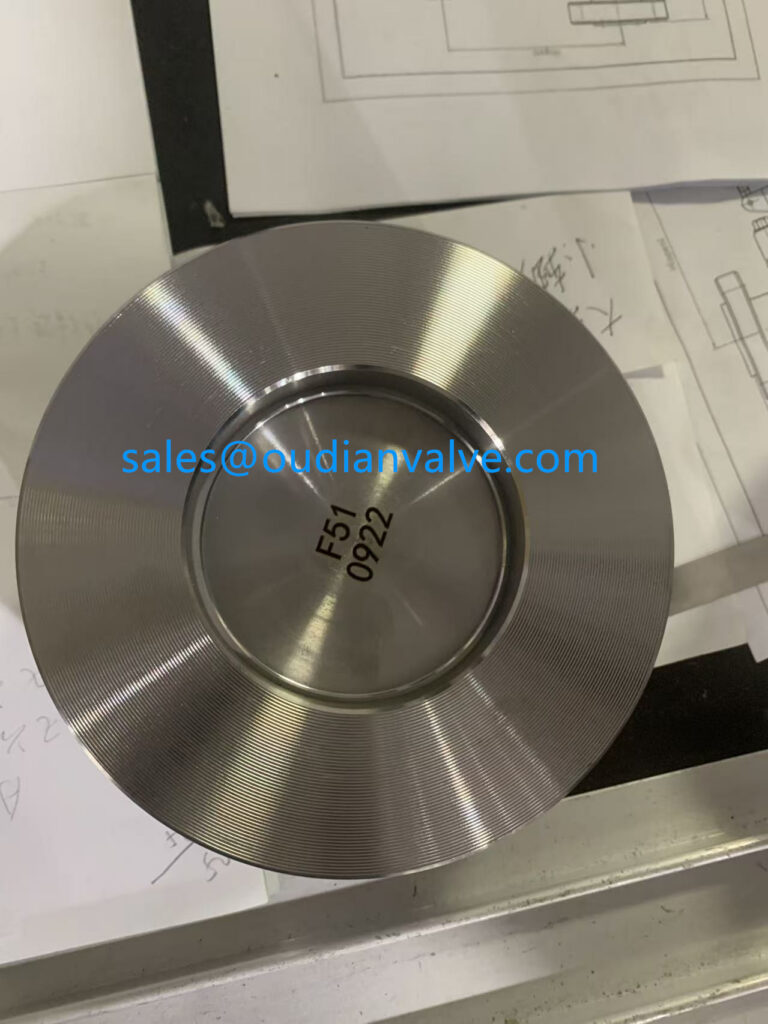
Seating arrangements also vary based on service requirements. Swing check valves often utilize broad metal seat faces to resist scouring from heavy slurries or soft elastomeric inserts for bubble-tight low-pressure gas service. Spring loaded check valves rely on precision-machined seats with elastomeric O-rings or ground metal faces that achieve rapid shutoff under tight dimensional tolerances.
Internal guide stems in spring loaded valves require clean, non-scaling fluids to prevent poppet binding, whereas swing check pivot pins tolerate moderate suspended solids without seizing.
Flow Resistance, Waterway Geometry, and Pressure Drop
Piping system efficiency depends heavily on the cumulative pressure drop generated by in-line components. Valve internal geometry dictates turbulence, friction losses, and the operational pumping power required to sustain design flow rates.
Swing check valves are renowned for offering a full, virtually unobstructed waterway when fully opened. In a properly sized swing check valve, the disc swings completely clear of the main bore, resting in a recessed pocket within the valve body bonnet. This full-port design produces minimal turbulence, yielding a very low flow coefficient loss and negligible head loss across high-volume pipelines.
Spring loaded check valves present a more restricted flow path because the internal spring, guide ribs, and poppet body remain positioned directly in the center of the fluid stream. As fluid passes around the poppet and through internal annular passages, velocity changes and boundary layer friction generate continuous hydrodynamic resistance. Consequently, spring loaded check valves exhibit higher pressure drops than equivalent-size swing check valves under identical volumetric flow rates.
Swing Check Flow Path
Fluid moves through a straight-through bore with minimal directional deflection. This configuration reduces energy consumption in large municipal water mains and continuous raw fluid transfer lines.
Spring Check Flow Path
Fluid must diverge around central guide mechanisms and overcome spring tension. This internal deflection creates continuous pressure loss but maintains uniform fluid velocity profiles around the sealing face.
Sizing considerations are critical for both styles to avoid premature mechanical failure. An oversized swing check valve operating at low flow velocities will experience severe disc flutter, causing rapid hinge pin wear. Conversely, an undersized spring check valve produces excessive pumping penalties and elevated acoustic noise across continuous duty cycles.
Cracking Pressure and Low-Pressure Flow Dynamics
Cracking pressure represents the minimum upstream differential pressure required to initiate flow and separate the sealing disc from its seat. Understanding cracking pressure dynamics is essential when designing low-pressure return lines, vacuum systems, or gravity-drain circuits.
Swing check valves possess an exceptionally low cracking pressure because they do not contain a mechanical pre-load device. Forward fluid need only overcome the physical weight of the unlatched disc and hinge assembly resting on the angled seat face. In horizontal lines with low forward differential pressure, even slight forward fluid movement displaces the disc, allowing fluid transmission without stalling the upstream source.
Spring loaded check valves require the upstream fluid to generate sufficient force to compress the pre-loaded spring before any media can pass. Manufacturers supply springs with diverse pre-set ratings to accommodate varying backflow prevention criteria. In applications powered by low-head pumps or atmospheric drainage, a stiff spring can completely block forward flow or cause system hunting where the valve repeatedly chatters against the seat.
Swing Valve Cracking Dynamics
- Requires minimal differential pressure to displace unweighted discs.
- Enables gravity drainage and low-head circulation without flow choking.
- Prone to disc hesitation if differential pressure remains near static equilibrium.
Spring Valve Cracking Dynamics
- Demands deliberate forward force to overcome engineered spring pre-load.
- Establishes positive cracking thresholds that prevent premature seeping.
- Maintains reliable poppet stability once cracking pressure is exceeded.
Selecting the correct spring stiffness avoids unnecessary head loss while maintaining closing authority. When specifying valves for low-pressure chemical dosage or atmospheric vent lines, verifying line operating pressure against valve cracking thresholds prevents unintended flow blockages.
Closing Speed, Reverse Flow Dynamics, and Water Hammer
Water hammer is a destructive hydraulic shock wave caused by the sudden deceleration or reversal of fluid flow in a closed conduit. Check valve closing speed directly determines the magnitude of this pressure spike during sudden pump trips or rapid downstream valve closures.
In standard swing check valves, the closing mechanism exhibits significant inertial lag. Because the disc must travel through an extended angular arc to reach the seat, it relies on returning fluid to carry it into the closed position. In piping networks with steep hydraulic gradients, reversing fluid accelerates before the disc completes its swing, driving the heavy metal disc violently into the seat ring and producing loud valve slam and intense pressure transients.
Spring loaded check valves eliminate closing lag by actively returning the disc toward the seat the moment forward flow velocity drops. The internal spring provides instantaneous closing force, seating the poppet at the precise instant fluid velocity reaches zero, before reverse flow can initiate. By preventing fluid reversal entirely, spring loaded check valves effectively prevent valve slam and protect connected piping, instrumentation, and pump casings from structural damage.

Installing standard swing check valves on high-head pump discharge lines introduces severe water hammer risks during sudden power outages, potentially fracturing pipe joints or pump volutes.
Adding external counterweights, lever arms, or hydraulic dashpots to swing check valves can modulate closing characteristics, but these accessories increase external space footprints and require regular packing adjustment. Spring loaded non-slam check valves resolve hydraulic transients internally without external linkages.
Piping Orientation and Mounting Geometry Restrictions
Spatial constraints within industrial plants, boiler rooms, and pump skids frequently dictate unconventional piping layouts. A valve design must match the physical run orientation to operate safely throughout its service life.
Swing check valves are fundamentally dependent on gravity to support proper seating behavior. Consequently, standard swing check valves are engineered primarily for horizontal pipe runs where the hinge pin sits horizontally above the centerline of the pipe. While they can function in vertical pipelines with upward flow, they must never be installed in vertical piping with downward flow because gravity holds the disc open, completely eliminating backflow prevention.
Spring loaded check valves operate independently of gravitational force due to the continuous mechanical bias exerted by the internal spring. This mechanical independence permits universal installation in horizontal runs, vertical runs with upward flow, vertical runs with downward flow, and even angled or inclined piping layouts. The spring maintains concentric disc alignment and positive seat contact regardless of spatial attitude.
Horizontale Rohrleitungen
Both valve types perform reliably in horizontal pipelines, though swing check valves provide lower energy consumption across continuous flow operations.
Vertical Upward Piping
Both valve styles can handle upward vertical flow, but spring check valves close much faster when upstream pumps trip, preventing flow reversal down the riser.
Vertical Downward Piping
Only spring loaded check valves function in downward vertical runs, as their spring force overcomes gravity to hold the disc closed against backpressure.
When engineering tight skid assemblies or retrofitting older facilities with complex multi-plane piping configurations, spring loaded valves offer unmatched layout flexibility. Swing check valves demand strict adherence to straight horizontal runs with adequate upstream and downstream straight pipe diameters.
Spatial Footprint, Weight, and Piping Support Requirements
The external dimensions and overall mass of a check valve influence structural pipe support requirements, valve vault construction costs, and equipment layout densities. Physical envelope differences between swing and spring designs become particularly noticeable in larger pipe diameters.
Traditional swing check valves are manufactured with full flanged end connections to accommodate the internal swing clearances of the disc arm. The overall face-to-face dimensions must provide sufficient interior cavity length so the disc can fully open without striking adjacent pipe walls or downstream companion flanges. This extended valve body requires substantial installation space, heavy structural pipe hangers, and wide clearance envelopes for top-mounted access bonnets.
Spring loaded check valves are widely produced in ultra-compact wafer, lug, and flangeless designs that sandwich directly between standard ANSI or DIN pipeline flanges. These compact bodies eliminate extended face-to-face requirements and weigh substantially less than flanged swing check valves of identical pipe size. The reduction in physical mass simplifies handling during installation, reduces pipe stress, and facilitates compact skid packaging.
Compact wafer spring check valves can reduce installation face-to-face dimensions and valve weight, simplifying structural support engineering on elevated pipe racks.
In subterranean valve vaults or tight marine engine rooms, the compact footprint of a wafer spring check valve allows smaller access chambers, reducing civil construction expenses. However, piping engineers must verify that the compact wafer disc does not interfere with lining materials or butterfly valve discs installed nearby.
Wear Mechanisms, Inspection Access, and Maintenance Demands
Routine maintenance schedules and component wear rates dictate total lifecycle costs for industrial valves. Swing and spring check valves experience distinct mechanical failure modes that require specific inspection and refurbishment routines.
Swing check valves are susceptible to hinge pin wear, bush ovalization, and disc detachment caused by continuous turbulence and disc flutter. When fluid velocity is erratic or lower than the minimum full-open threshold, the disc hovers in the flow stream, repeatedly oscillating and wearing the pivot mechanism. However, top-bolted bonnets provide exceptional field serviceability, enabling maintenance personnel to inspect, clean, and reface internal seats without removing the valve body from the pipeline.
Spring loaded check valves experience mechanical spring relaxation, cyclic fatigue, and guide stem binding. Over millions of rapid cycles, internal springs can lose their pre-load tension or suffer stress-corrosion cracking, particularly in aggressive chemical or high-temperature steam environments. Furthermore, because wafer-style spring valves lack a bolted top bonnet, servicing the internal components usually requires removing the entire valve assembly from between pipe flanges.
- Inspect swing check valve hinge pins periodically for mechanical play, shaft scoring, and loose disc retaining fasteners.
- Examine spring loaded poppet guide bushings for mineral scale, slurry buildup, or particulate binding that could impede axial travel.
- Check internal helical springs for stress cracking, loss of free height, or chemical pitting during scheduled system turnarounds.
Evaluating fluid cleanliness is paramount when predicting service life. In dirty media, swing check mechanisms offer superior operational longevity because their wide clearances tolerate solids, whereas spring check guide stems can jam if grit migrates into sliding clearances.
Performance Under Extreme Temperatures and Operating Pressures
Operating temperature and pressure ratings establish the physical envelope within which non-return valves function safely. Elevated temperatures affect material yield strength, spring elasticity, and elastomeric seal integrity.
Swing check valves perform reliably across broad temperature and pressure regimes, from cryogenic liquefied gas to superheated steam service. Because standard swing mechanisms do not rely on high-tensile spring steel, they avoid the risk of high-temperature spring relaxation. Heavy forged steel swing check valves with stellite-faced metal seats easily withstand high-pressure, high-temperature boiler feed cycles where mechanical springs might lose temper and yield.
Spring loaded check valves require specialized spring metallurgy when exposed to elevated thermal cycles or corrosive chemical streams. Standard stainless steel springs can experience accelerated fatigue or relaxation when subjected to high temperatures, diminishing closing force over time. For severe service, springs must be fabricated from advanced alloys such as Inconel, Monel, or Hastelloy to resist thermal degradation and stress-corrosion cracking.
High-Temperature Steam
Swing check valves with hardfaced metal seats withstand continuous thermal soaking without mechanical component fatigue or loss of closing capability.
Cryogenic Liquefied Gas
Spring loaded check valves provide immediate positive sealing in cold media, provided specialized low-temperature spring alloys are specified to avoid brittle fracture.
Pulsating Compressor Discharge
Spring check valves resist flutter under pulsating gas flows, whereas swing discs rapidly wear out hinge pins under reciprocating compressor cycles.
Pressure envelope limits are equally vital. In high-pressure Class 1500 or 2500 lines, forged swing check valves offer massive wall sections that handle hydraulic surges, while spring loaded poppet designs provide silent closure that mitigates catastrophic shock wave propagation.
Swing Type Check Valve vs Spring Loaded Check Valve: Technical Comparison
Direct mechanical and hydraulic comparison clarifies the performance trade-offs between swing type check valve vs spring loaded check valve architectures. Selecting the right valve requires balancing energy efficiency against dynamic surge protection.
The comparative matrix below outlines key engineering criteria, demonstrating how internal design choices govern system performance, maintenance protocols, and physical layout requirements.
| Engineering Parameter | Swing Type Check Valve | Spring Loaded Check Valve | Operational Significance |
| Closure Mechanism | Hinged swinging disc | Spring-biased poppet | Governs mechanical movement and kinetic response time. |
| Closing Speed | Moderate to slow | Rapid and positive | Directly influences reverse velocity and slam potential. |
| Water Hammer Risk | Moderate to high | Low to negligible | Determines susceptibility to hydraulic shock waves. |
| Strömungswiderstand | Very low | Moderate to high | Dictates long-term pumping power and head loss. |
| Cracking Pressure | Negligible | Engineered pre-set | Affects low-pressure flow and gravity drain lines. |
| Mounting Orientation | Horizontal or vertical-up | Universal all positions | Dictates physical piping design and skid packaging. |
| Solids Handling | Moderate to excellent | Clean media only | Affects reliability in slurries, raw water, and wastewater. |
| Internal Wear Modes | Hinge pin wear | Spring fatigue | Defines component inspection schedules and failure modes. |
| In-Line Maintenance | Accessible via bonnet | Requires line removal | Influences field turnaround duration and labor costs. |
| Space Footprint | Large flanged body | Compact wafer design | Impacts vault sizing and structural support loads. |
Reviewing these engineering parameters ensures that the selected non-return valve aligns with both the hydraulic characteristics of the fluid and the structural demands of the pipeline network.
Structural Advantages and Engineering Limitations
Each check valve style provides clear operational strengths alongside specific engineering boundaries. Weighing these trade-offs ensures that non-return devices perform reliably without introducing unmanageable maintenance liabilities.
Swing check valves excel where fluid pathways must remain clear and pumping energy must be conserved. However, their slow closing dynamics make them hazardous in rapid-deceleration systems where water hammer can develop.
Swing Valve Advantages
- Provides an unobstructed full-port waterway with minimal hydraulic head loss.
- Accommodates moderate suspended solids, viscous fluids, and wastewater slurries.
- Features a bolted top bonnet for convenient in-line inspection and seat refacing.
Swing Valve Limitations
- Prone to violent disc slamming and water hammer during sudden pump shutoffs.
- Restricted strictly to horizontal or vertical-upward piping configurations.
- Susceptible to severe hinge pin wear and disc flutter under low flow velocities.
Spring loaded check valves provide silent, rapid shutoff and universal mounting flexibility, yet their internal mechanisms introduce head loss and require clean operating fluids.
Spring Valve Advantages
- Closes before flow reversal occurs, actively preventing destructive water hammer.
- Installs in any orientation, including horizontal, vertical-up, and vertical-down runs.
- Features a compact, lightweight wafer body that minimizes piping support requirements.
Spring Valve Limitations
- Creates a continuous pressure drop due to internal spring and guide obstructions.
- Vulnerable to poppet binding and guide jamming in particulate-laden fluids.
- Exhibits potential spring fatigue and relaxation under sustained thermal stress.
System Selection Across Industrial and Municipal Applications
Matching valve mechanics to specific application demands prevents pipeline failure, lowers operating costs, and safeguards equipment. Operating conditions such as media cleanliness, flow pulsation, and surge sensitivity dictate the optimal valve choice.
Pump discharge headers, municipal water distribution, wastewater handling, and chemical process piping each impose unique stresses on non-return devices.

Pumping Stations
Centrifugal pump discharge lines subject to sudden power trips require spring loaded check valves. Rapid spring closure arrests reverse flow instantly, protecting pump impellers and suppressing hydraulic shock waves.
Wastewater & Slurry
Raw sewage, pulp stock, and particulate slurries demand swing check valves. The open waterway allows suspended solids and stringy fibrous debris to pass freely without catching on internal springs or guide ribs.
Process & Gas Piping
Reciprocating compressor lines and chemical dosage systems benefit from spring loaded valves. Spring damping eliminates disc flutter under pulsating flows, and diverse alloy springs resist aggressive chemicals.
When selecting valves for multi-pump manifolds connected to a shared discharge header, spring loaded check valves prevent severe reverse-flow spinning of idle pumps. In long-distance gravity transmission aqueducts where energy loss must be minimized and flow changes occur gradually, swing check valves remain the preferred engineering choice.
Frequently Asked Questions
Can a swing check valve be installed in a vertical pipe run?
A swing check valve can be installed in a vertical pipe run only when the fluid flows upward. It must never be installed in vertical downward piping because gravity will pull the disc open, completely preventing reverse flow shutoff.
Why do spring loaded check valves prevent water hammer more effectively?
Spring loaded check valves prevent water hammer by using internal spring force to close the disc at zero flow velocity before reverse flow can initiate. Standard swing check valves close more slowly, allowing reverse velocity to slam the disc against the seat.
Which check valve produces a lower pressure drop during continuous operation?
Swing check valves produce a substantially lower pressure drop because the disc swings completely clear of the flow path, creating a full-port waterway. Spring loaded check valves keep the poppet and spring assembly in the center of the flow, generating higher hydrodynamic resistance.
Are spring loaded check valves suitable for raw sewage and wastewater slurries?
Spring loaded check valves are generally unsuitable for raw sewage and heavy slurries because fibrous debris and particulate matter can catch on the spring and guide bushings. Swing check valves, particularly those with contoured rubber-flapper discs, are preferred for handling solids.
What causes disc flutter in swing check valves, and how can it be avoided?
Disc flutter occurs when line flow velocity is insufficient to hold the swing disc fully open, causing it to oscillate repeatedly on its hinge pin. It can be avoided by sizing the valve to match actual system flow velocities rather than pipe nominal diameter, or by switching to a spring loaded design.
Final System Specification Takeaways
Evaluating a swing type check valve vs spring loaded check valve requires balancing low pressure drop against rapid closing dynamics and mounting flexibility. Specifying swing check valves preserves energy across large, uninterrupted horizontal water and slurry lines, while spring loaded check valves provide silent, non-slam backflow prevention that protects pumps and piping from destructive pressure surges across any installation angle.