


Key Features of 2205 Ball Valve for Industrial Use
You need a valve that can handle hard work. The 2205 ball valve is strong because it uses a special material. This material does not crack easily under stress. Many ball valves break in tough places, but the right material can stop about 70% of these breaks.
- The material in this valve works well in offshore and desalination plants.
- You get good sealing because the material does not get damaged by harsh liquids.
- The material also helps the valve last longer in petrochemical, marine, and medical systems.
Key Takeaways
- The 2205 ball valve is made from duplex stainless steel. This metal is very strong and does not rust easily. It works well in tough places like oil and gas sites.
- This valve has a smart sealing design. It stops leaks and keeps things safe. It helps the valve work well in many factories.
- You can turn the 2205 ball valve 90° to use it. It is easy to use and can be set up to work by itself. This saves time and energy when moving liquids.
- You need to check and clean the valve often. This helps it work well for a long time.
- Picking the right seat material for your job is important. It helps the valve work better and last longer. This makes sure it fits your system’s needs.
2205 Ball Valve Features

Corrosion Resistance
You need a valve that works in harsh places. The 2205 ball valve uses a special alloy that fights rust. This alloy has a mix of two types of steel. It has both austenitic and ferritic parts. The high chromium and molybdenum help protect the valve from damage.
- Duplex Stainless Steel 2205 does not get pitting or crevice corrosion, even with lots of chloride.
- The low carbon stops intergranular corrosion from happening.
- This material also helps stop erosion corrosion and corrosion fatigue.
- Grade 2205 is very good at fighting corrosion and is also strong.
- Stainless Steel 304 and 316 do not work as well as Duplex 2205 in tough places.
You can use the 2205 ball valve in petrochemical, marine, and medical systems. The valve stays smooth and easy to clean, even with strong chemicals. You get great corrosion resistance, so the valve lasts a long time.
Sealing Performance
You want a valve that does not leak. The 2205 ball valve seals well because of its smart design and strong materials. OUdian uses a trunnion mounted design and special sealing technology. This keeps the valve tight, even when the pressure is low.
Tip: The special sealing keeps the valve tight, so you do not have to worry about leaks.
Here is a table that shows the sealing materials:
| Sealing Material | Description |
|---|---|
| Metal-to-metal seal | Makes a strong seal that can handle high pressure. |
| Optional PTFE/Graphite | Helps keep the valve tight in tough situations. |
| Fire-Safe Design | Meets API 607 rules, so it works in fires. |
You get great sealing with seat materials like PTFE, RPTFE, DEVLON, NYLON, and PEEK. The valve also seals well at the stem, which lowers emissions and keeps things safe. The smooth inside stops buildup and makes cleaning easy.
Strength and Durability
You need a valve that is strong and lasts long. The 2205 ball valve is tough and bends without breaking. The solid ball and strong body make it good for hard jobs.
| Tensile Strength | Yield Strength (0.2% Offset) |
|---|---|
| Psi – 116000 , MPa – 800 | Psi – 80000 , MPa – 550 |
You get great corrosion resistance and strength, so the valve does not crack or bend. The fire protection-antistatic part makes it even safer. The valve stays smooth and easy to clean, even after many years.
Operational Convenience
You want a valve that is fast and easy to use. The 2205 ball valve opens or closes with a quick 90° turn. This is good for places where you need to use valves a lot. The design lets fluid move easily, so you save energy and work better.
- You get low fluid resistance when moving liquids.
- The valve is easy to automate, so you can control it from far away with electric, pneumatic, or hydraulic actuators.
- You get fast and easy use, which saves time and keeps you safe.
- The smooth inside helps fluids move and makes cleaning simple.
OUdian’s 2205 ball valve meets DIN standards. You can pick from different end connections, like flanged RF, RTJ, and butt weld. Here is a table of common connection types:
| Connection Type |
|---|
| Tube End |
| Threaded |
| Socket Weld |
| Butt Weld |
| Flanged |
| Weld Nipple |
| SAE |
You get many ways to install it and can trust it in any industrial place.
Duplex Stainless Steel Ball Valves
Duplex Stainless Steel Properties
Duplex stainless steel ball valves are made for hard jobs. This steel mixes two types together. The mix makes the valve strong and stops rust. You can use these valves with strong chemicals or salty water. The special design helps the valve last longer. It also helps the valve work better.
Here is a table that shows why duplex stainless steel ball valves are special:
| Property | Description |
|---|---|
| Chloride Stress Corrosion Resistance | Handles tough places easily. |
| Pitting Corrosion Resistance | Stops tiny holes, even in salty or sour spots. |
| Mechanical Properties | Twice as strong as normal stainless steel. |
| Weldability | Easy to join with other metals, no extra steps. |
| Thermal Conductivity | Moves heat well and does not get bigger too fast. |
| Corrosion Fatigue and Wear Resistance | Stays strong when facing stress and chemicals. |
Duplex stainless steel ball valves have lots of chromium, molybdenum, and nitrogen. These parts give the valve a PREN of 34 or more. This means the valve fights rust and damage better than most other materials.
| Element | Percentage |
|---|---|
| Cr | 22% |
| Mo | 3% |
| N | 0.18% |
| PREN | ≥ 34 |
Advantages Over Standard Stainless Steel
You want valves that last and work well. Duplex stainless steel ball valves are better than regular stainless steel valves. Here are some reasons why:
- Duplex stainless steel ball valves fight rust better than 316L and 304 stainless steel, especially in places with lots of chloride.
- You do not need to worry about stress corrosion cracking, which is a big problem for regular stainless steel.
- These valves work well with many chemicals, like acetic and formic acids.
- Duplex stainless steel ball valves have a yield strength of at least 450 MPa. Regular stainless steel, like 304 or 316, only has about 205 MPa.
- You can use duplex stainless steel ball valves in high-pressure and corrosive places, like oil and gas plants.
Here is a table that compares the strength of different materials:
| Material | Yield Strength (MPa) |
|---|---|
| Duplex 2205 | ≥450 |
| Austenitic 304 | ~205 |
| Austenitic 316/L | ~205 |
Tip: If you pick duplex stainless steel ball valves, you get a valve that is strong, safe, and lasts a long time. You can trust these valves in tough places.
Duplex steel ball valves give you the best mix of strength and rust resistance. You can count on them to work well in any industry.
Duplex 2205 Ball Valve Specification
Size and Pressure Ratings
It is important to know the size and pressure before picking a valve. Duplex 2205 ball valves come in many sizes and can handle different pressures. You can use them in small pipes or big factories. The body is made from duplex stainless steel, which is very strong. This helps the valve work well when there is a lot of force.
Here is a table that shows the usual sizes and pressure ratings for duplex 2205 ball valves:
| Size Range | Pressure Rating |
|---|---|
| 2”~48” | ASME CL150, 300, 600 |
You can choose valves from DN15 up to DN200. The pressure ratings start at PN16 and go up to PN25. Some types can even handle up to 2500LB. The ball inside is solid and forged, so it is extra strong. If you need a special size or pressure, you can ask for it.
Tip: Always look at the duplex 2205 ball valve specification to make sure it fits your system.
Construction Standards
You want a valve that follows strict rules. Duplex stainless steel ball valves meet many world standards. These rules help you trust the valve in hard places. The duplex 2205 ball valve meets DIN, API, and ASME standards. You can use these valves in oil, gas, chemical, and marine jobs.
Here is a table that lists the main standards for duplex stainless steel ball valves:
| Standard Type | Standards Met |
|---|---|
| API | API 600, API 598, API 6D, API 607 |
| ASME | ASME B 16.10, ASME B 16.5, ASME B 16.25, ASME B 16.34 |
| DIN | DIN3357, DIN EN1092, DIN3230 |
| Other | BS1414, BS EN 12266-1, MSS SP-55, MSS SP-25 |
You can get valves with flanged RF, RTJ, or butt weld ends. The design uses special sealing, so the valve stays tight even when pressure is low. You can pick spring-loaded packing or low emission packing to help stop leaks and keep your system safe.
Seat Materials and Performance
The seat material is important for how the valve works. Duplex stainless steel ball valves use different seat materials for different jobs. You can pick soft seats for low pressure or hard seats for high pressure. Each seat material has its own good points.
Here is a table that shows the most common seat materials and what they do:
| Seat Material | Type | Key Properties | Suitable Pressure Range |
|---|---|---|---|
| PTFE | Soft Seat | Chemically stable, low friction, non-reactive | Up to CL600 |
| TFM1600 | Soft Seat | Enhanced mechanical properties, suitable for medium pressures | Up to CL800 |
| C-RPTFE | Soft Seat | Improved mechanical properties, ideal for medium/high pressure | Up to CL900 |
| DELRIN | Hard Seat | Dimensional stability, mechanical strength, suitable for high pressures | Up to CL2500 |
| PEEK | Hard Seat | Excellent mechanical and thermal properties, suitable for very high pressures | Up to CL6000 |
| Stainless Steel | Metal Seat | Corrosion resistance, high mechanical properties, suitable for very high pressures | Very high pressures |
You can see how each seat material works with different pressures in the chart below:
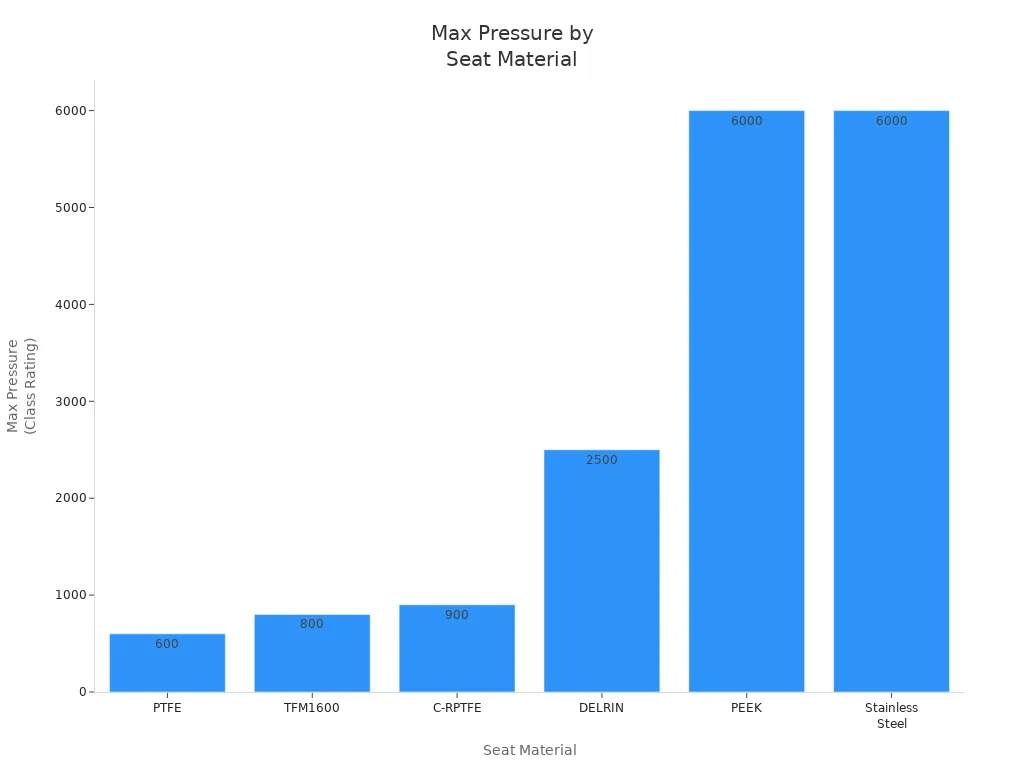
You can pick the seat material that matches your needs. PTFE is good for low pressure and clean liquids. PEEK and stainless steel seats are best for very high pressure and strong chemicals. Picking the right seat material helps your valve last longer and work better.
Note: Always match the seat material to your system’s pressure and media for the best results.
You can trust duplex stainless steel ball valves to do the job. The duplex 2205 ball valve specification gives you lots of choices for size, pressure, and seat material. You get strong valves that seal well and last a long time. These valves work great in oil, gas, chemical, and marine jobs.
Applications
Oil and Gas
Oil and gas work can be very hard. High pressure and heat can break regular valves. Duplex stainless steel ball valves fix these problems. The 2205 ball valve is made with strong materials. It has a smart design. This valve works well when pressure is high. It also works when the temperature goes up.
- High pressure and heat do not make leaks or breaks.
- The valve resists corrosion and erosion, so your system stays safe.
- You can use duplex stainless steel ball valves in upstream and downstream jobs.
These valves help you avoid stopping work. They keep your process running without trouble.
Chemical Processing
Chemical plants need valves that work well. Duplex stainless steel ball valves are good for chemical processing. They resist corrosion and are strong. This makes them great for handling harsh chemicals.
| Application Area | Description |
|---|---|
| Chemical process vessels | Hold many chemicals safely and reliably. |
| Piping | Move fluids without leaks or damage. |
| Heat exchangers | Control heat in chemical systems. |
Duplex stainless steel ball valves help you control flow in chemical plants. They protect your equipment. You get good performance, even with strong acids or bases.
Marine and Offshore
Marine and offshore jobs have saltwater and tough weather. Corrosion is a big problem here. Duplex stainless steel ball valves use 22Cr duplex stainless steel. This material is used in most offshore valves.
- Saltwater and salty air do not harm these valves.
- Gases like carbon dioxide and hydrogen sulfide do not cause inside corrosion.
- You get strong valves for ships, rigs, and offshore platforms.
Duplex stainless steel ball valves help you avoid expensive repairs. They keep your systems safe.
Medical and Water Treatment
You need clean water and safe medical systems. Duplex stainless steel ball valves help with this. These valves resist corrosion and erosion. They work well in places like seawater or chemical treatment plants.
- They can handle hot water because they resist heat.
- Their strength keeps them working under pressure.
- They save money because they last a long time.
- They are easy to shape and recycle, which helps the environment.
You can trust duplex stainless steel ball valves to keep water and medical systems working well.
Maintenance and Safety
Installation and Operation
You want these valves to work well right away. First, check the valve for any damage before you put it in. Make sure the pipeline is clean and has no dirt inside. Line up the valve with the pipe and pick the right end connection, like flanged RF, RTJ, or butt weld. Tighten the bolts the same amount so there are no leaks. When you use the valve, turn the handle gently. The handle turns 90° to open or close the valve fast. Always read and follow the instructions from the maker to stay safe. If you use actuators, make sure the controls work right. These valves help you control flow easily and keep your system safe.
Maintenance Practices
Taking care of these valves helps them last longer. Look at the valve often for any damage or rust. Clean the valve and its parts with the right cleaner for each material. Use gasoline for metal parts. Use pure water or alcohol for non-metal parts. Take away pressure from both sides before taking the valve apart. Use special tools for O-rings so you do not break them. Clean new parts before putting them in. Put grease on moving parts that works with these valves. Put the valve back together after the cleaner dries so it does not rust. Tighten the flange bolts in a crisscross way. Doing these things keeps the valves working well.
| Maintenance Practice | Description |
|---|---|
| Pressure Removal | Remove pressure in upstream and downstream pipelines before disassembly. |
| Careful Disassembly | Avoid damaging sealing surfaces; use special tools for O-rings. |
| Symmetrical Tightening | Tighten flange bolts evenly during assembly. |
| Compatible Cleaning | Use cleaning agents that match all parts. |
| Immersion Cleaning | Clean parts by immersion; wipe metal parts with a soaked cloth. |
| Immediate Removal | Do not soak non-metallic parts for long. |
| Assembly Timing | Assemble after cleaning agent evaporates. |
| New Parts Cleaning | Clean new parts before assembly. |
| Lubrication | Use compatible lubricating grease for all materials. |
Safety Features
These valves have safety features to protect you and your equipment. You get strong lockouts made from duplex stainless steel ball valves. These lockouts stop the valve from moving by accident when you do repairs. The lockout uses a puck and disc to block the valve shaft. Even if someone tries to turn the valve, the shaft will not move. This keeps the valve safe in busy places.
- Safety lockouts use duplex stainless steel ball valves for extra strength.
- Lockouts stop the valve from moving by accident during repairs.
- The puck and disc lockout stops the shaft from turning.
Tip: Always use the safety features on these valves to stop accidents and keep your system safe.
You can trust these valves to work safely in any factory or plant.
The 2205 ball valve works well and lasts a long time. Duplex stainless steel stops rust and handles strong pressure. You can use this valve in oil, gas, chemical, and marine places. The smart design makes it easy and safe to use.
Tip: Pick duplex stainless steel ball valves for hard jobs. They keep your system safe and help you work better.
| Key Benefit | Why It Matters |
|---|---|
| Corrosion Resistance | You fix things less often |
| High Strength | It works in tough spots |
| Easy Operation | You save time and energy |
FAQ
What makes the 2205 ball valve better for harsh environments?
You get strong protection against rust and chemicals. The duplex stainless steel resists damage from saltwater, acids, and high pressure. This means you can use the valve in tough places like oil rigs or chemical plants.
Can you use the 2205 ball valve with different fluids?
Yes, you can. The valve works with water, oil, gas, and many chemicals. You can choose seat materials like PTFE or PEEK to match your fluid type and pressure needs.
How do you install a 2205 ball valve?
You line up the valve with your pipe. You pick the right end connection, such as flanged or butt weld. You tighten the bolts evenly. You follow the instructions from the manufacturer for safe installation.
How often should you check or maintain the valve?
You should inspect the valve regularly. You clean the parts and check for leaks or rust. You replace worn seals when needed. Regular care helps your valve last longer and work safely.