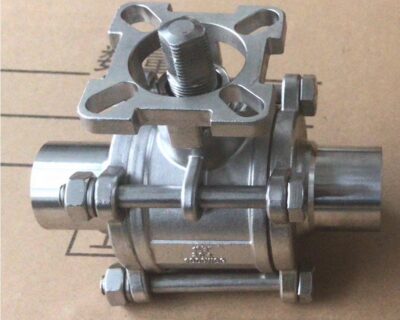


Floating Ball Valve: Definition, Working Principle, and Comparison with Trunnion Ball Valves
1. Definition of a Floating Ball Valve

A floating ball valve is a quarter-turn valve that uses a spherical disc (the “ball”) to control flow. The ball is not rigidly fixed to the stem, allowing it to float slightly under pressure. When closed, the ball is pressed against the downstream seat, creating a tight seal.
Key Features:
✔ Floating Design – The ball is held in place by two valve seats but can move slightly under pressure.
✔ Bidirectional Sealing – Can seal in both flow directions but typically performs better when pressure comes from one side.
✔ Common Sizes – Best suited for small to medium-sized valves (typically up to 10 inches).
✔ Materials – Available in carbon steel, stainless steel, brass, and plastics (for corrosive applications).
2. Working Principle of a Floating Ball Valve
How It Works:
Open Position – The ball’s bore aligns with the pipeline, allowing fluid to pass through.
Closed Position – The ball rotates 90 degrees, blocking flow.
Downstream Pressure pushes the ball against the seat, enhancing the seal.
Sealing Mechanism –
The upstream seat provides minor support.
The downstream seat takes most of the pressure, ensuring tight shutoff.
Advantages:
✅ Simple & Cost-Effective – Fewer moving parts than trunnion valves.
✅ Good for Low/Medium Pressure – Works well in PN16 to PN40 (Class 150-300) applications.
✅ Compact & Lightweight – Ideal for space-constrained installations.
Disadvantages:
❌ Limited to Smaller Sizes – Not ideal for large-diameter, high-pressure systems.
❌ Higher Torque Required – Sealing force increases with pressure, requiring more effort to operate.
❌ Potential Seat Wear – Continuous high pressure can degrade soft seats over time.
3. Floating Ball Valve vs. Trunnion Ball Valve
| Feature | Floating Ball Valve | Trunnion Ball Valve |
|---|---|---|
| Ball Support | Floats between seats | Fixed by trunnions (mechanical anchors) |
| Pressure Handling | Best for low to medium pressure (Class 150-300) | Handles high pressure (Class 600-2500) |
| Size Range | Up to 10 inches | Up to 60 inches+ |
| Sealing Mechanism | Downstream pressure-assisted | Dual-piston effect (seals on both sides) |
| Torque Requirement | Higher under pressure | Lower, even at high pressures |
| Cost | More economical | More expensive due to complex design |
| Applications | Water, air, oil/gas (low-pressure) | Oil & gas pipelines, high-pressure steam, cryogenics |
4. Common Applications
Floating Ball Valves Are Used In:
Water & wastewater treatment
Oil & gas (low-pressure pipelines)
Chemical processing (non-corrosive fluids)
HVAC systems
General industrial processes
Trunnion Ball Valves Are Preferred For:
High-pressure oil & gas transmission
Cryogenic (LNG) applications
Large-diameter pipelines (24-inch and above)
Severe-service (high-temperature, abrasive media)

300LB Trunnion Mounted Ball Valve
5. Which One Should You Choose?
Choose a Floating Ball Valve if:
You need a cost-effective solution for small to medium-sized pipelines.
The system operates at low to medium pressure (Class 150-300).
The valve is used for water, air, or light hydrocarbons.
Choose a Trunnion Ball Valve if:
You need a high-pressure (Class 600+), large-diameter valve.
The application involves cryogenics, sour gas, or abrasive fluids.
Reduced operating torque is critical.
Final Thoughts
Floating ball valves are simple, reliable, and economical for standard applications, while trunnion ball valves excel in high-pressure, large-scale, and severe-service environments. The choice depends on pressure, size, and operational requirements.
Need Help Choosing the Right Valve?
At Oudian valve, we offer both floating and trunnion-mounted ball valves, engineered for durability and optimized flow control across industries. If you’re unsure which type is best for your application:
→ Explore Our Full Ball Valve Portfolio
→ Contact Our Engineering Team to get personalized advice and specification support
Make the right choice—avoid performance risks and extend your system’s life cycle with expert-backed valve solutions.