


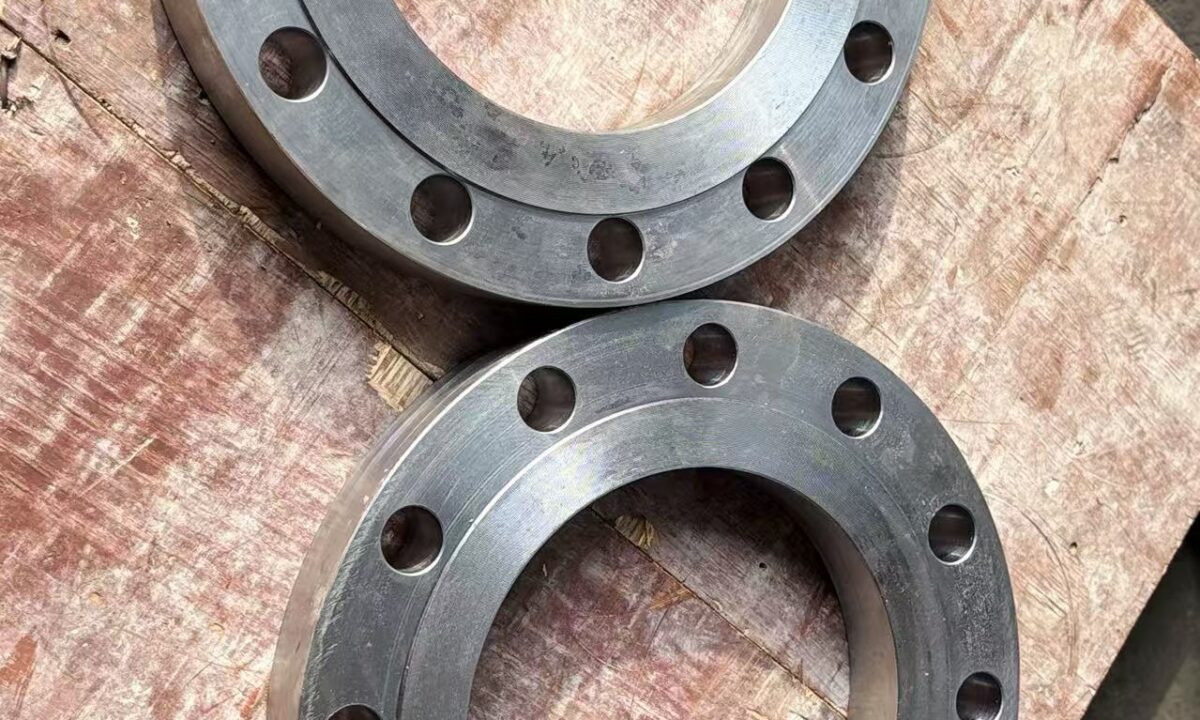
ASME B16.47 vs ASME B16.5
Operating conditions, external piping loads, and spatial restrictions determine which specific standard and series must be implemented. Large-diameter applications require extra scrutiny because ASME B16.47 splits into two distinct dimensional standards with completely different bolt circles and flange weights.
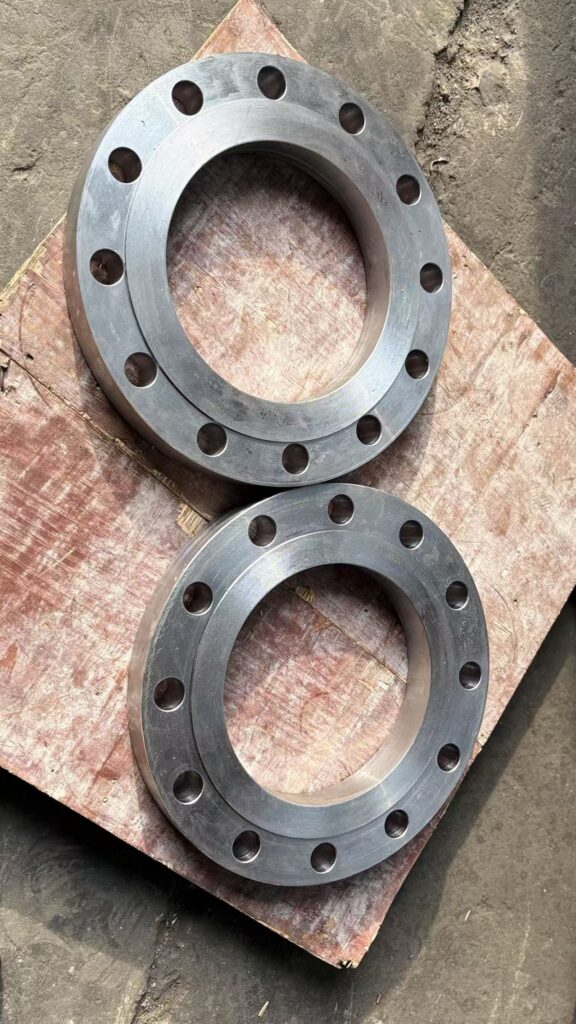
Flange Size Ranges and Applicable Standards
The boundary separating ASME B16.5 and ASME B16.47 is defined by the nominal diameter of the pipe. ASME B16.5 governs smaller through intermediate piping layouts up to 24 inches in nominal diameter, while ASME B16.47 governs large diameter piping systems above 24 inches.
Because ASME B16.5 addresses fittings as well as flanges, it includes dimensional specifications for flanged elbows, tees, and crosses. In contrast, ASME B16.47 covers only pipe flanges and does not include flanged fittings. Large-diameter piping systems rely instead on butt-weld fittings governed by companion specifications like ASME B16.9.
- ASME B16.5 specifies flanges and flanged fittings from NPS 1/2 up to and including NPS 24.
- ASME B16.47 provides dimensional criteria exclusively for flanges from NPS 26 through NPS 60.
- Piping configurations spanning across the NPS 24 boundary require transition planning between the differing design guidelines.
Pressure Ratings and Temperature Limits
Both standards calculate allowable working pressures across defined pressure classes using designated material groups. Operating temperature directly alters the maximum allowable working pressure of a flange material in both specifications.
ASME B16.5 establishes pressure-temperature ratings across Class 150, Class 300, Class 400, Class 600, Class 900, Class 1500, and Class 2500. Large diameter flanges specified under ASME B16.47 feature a narrower range of pressure ratings, spanning Class 150 through Class 900, with an additional Class 75 rating provided only for Series B flanges. The extreme hoop stress in large-diameter shells prevents standard high-pressure ratings such as Class 1500 or Class 2500 from being standardized in ASME B16.47.
Flange materials defined in both standards are organized by metallurgy groups in ASME B16.5 Table 1A, including carbon steel, low-alloy steel, stainless steel, and nickel alloys. Maximum allowable pressure decreases steadily as operating temperature rises, requiring material verification against the applicable material group table.
When operating temperatures reach elevated ranges, thermal expansion produces bending moments across the flange neck. Engineers calculate these stresses using material-specific rating tables before finalizing the pressure class selection.
Flange Styles and Gasket Facing Options
ASME B16.5 accommodates a broad collection of mechanical connections to address compact footprints, maintenance needs, and varied attachment methods. ASME B16.47 limits construction styles to those capable of sustaining massive bending moments and internal pressures.
Standard gasket facings across both specifications include raised face, flat face, and ring-type joint configurations. Raised face flanges feature standard serrated concentric or spiral grooves that grip sheet and spiral-wound gaskets during bolt torque application.
ASME B16.5 Flange Styles
Covers weld neck, slip-on, socket weld, threaded, lap joint, and blind flanges. This range provides design versatility for tight plant layouts, low-pressure utilities, and frequent disassembly points.
ASME B16.47 Flange Styles
Specifies only weld neck flanges and blind flanges. The mechanical demands of piping systems above NPS 24 eliminate weaker connection types like slip-on or socket weld styles from standard consideration.

Ring-type joint facings are common in higher pressure classes like Class 600 and Class 900 where metal ring gaskets resist high-pressure blowouts. Flat face variants are typically specified when mating against cast iron valves or fragile equipment nozzles to prevent high bending stresses.
ASME B16.47 Series A vs Series B Differences
ASME B16.47 incorporates two historical industrial standards into a single specification, dividing large-diameter flanges into Series A and Series B. These two series represent fundamentally different philosophies regarding flange rigidity, weight, and bolt configuration.
Series A flanges derive from the MSS SP-44 standard and feature heavier, thicker dimensions designed to resist external piping moments. Series B flanges originate from the API 605 standard, prioritizing a more compact profile with lower weight and tighter bolt spacing.
Series A Characteristics
- Derived from MSS SP-44 specifications
- Heavier cross-section and thicker flange ring
- Fewer bolts with larger individual bolt diameters
- Larger bolt circle diameter and greater weight
- Preferred for general pipeline and structural piping
Series B Characteristics
- Derived from API 605 specifications
- Lighter cross-section and thinner profile
- Higher bolt count with smaller bolt diameters
- Smaller bolt circle diameter and reduced weight
- Preferred for compact refinery equipment and manifolds
The difference between these designs creates distinct physical profiles on the job site. A Series A flange requires larger clearances for heavy torque wrenches, while a Series B flange demands careful bolt tightening sequences to distribute clamping loads evenly across its numerous smaller fasteners.
Bolt Patterns and Dimensional Characteristics
Bolt circle geometry controls joint integrity and directly dictates how clamping force transfers into the gasket. ASME B16.5 and ASME B16.47 maintain separate bolt hole diameters, bolt circle diameters, and fastener counts that reflect their operational scope.
Within ASME B16.47, the contrast in bolt patterns between Series A and Series B is pronounced. For an identical nominal pipe size and pressure rating, Series B uses a smaller bolt circle diameter combined with smaller, more numerous studs. Series A utilizes larger studs positioned on a wider bolt circle, producing higher individual bolt preloads.
Series A and Series B flanges cannot mate with one another because their bolt circle diameters, bolt hole quantities, and bolt diameters do not match. Attempting to bolt a Series A flange to a Series B flange will fail completely during installation.
Stud length also varies substantially between series due to differences in flange thickness. Engineers calculate stud bolt lengths based on flange thickness, gasket thickness, and nut height to verify proper thread engagement past the nut face.
ASME B16.47 vs ASME B16.5 Comparison
Comparing the primary characteristics of both standards highlights how design parameters shift as line size expands into large-diameter territory. The dimensional differences dictate manufacturing, handling, and installation practices.
| Parametru | ASME B16.5 | ASME B16.47 Series A | ASME B16.47 Series B |
| Interval de dimensiuni | NPS 1/2-24 | NPS 26-60 | NPS 26-60 |
| Clase de presiune | Class 150-2500 | Class 150-900 | Class 75-900 |
| Flange Types | Six Major Types | Weld Neck, Blind | Weld Neck, Blind |
| Bolt Pattern | Standardized Pitch | Fewer Larger Studs | More Smaller Studs |
| Historical Basis | ANSI B16.5 | MSS SP-44 | API 605 |
| Flange Weight | Proportional Weight | Substantially Heavier | Noticeably Lighter |
| Primary Usage | Process Piping | General Pipeline | Compact Equipment |
Each standard addresses specific structural challenges within its respective size boundary. While ASME B16.5 focuses on flexibility across fittings and components, ASME B16.47 focuses on managing weight, gasket stress, and deflection under high internal pressure.
Mating Compatibility and Interchangeability Rules
Flanges manufactured under ASME B16.5 and ASME B16.47 do not overlap in nominal pipe size, making physical interchangeability between the two standards impossible. Size ranges meet at the 24-inch boundary, but an NPS 24 flange cannot connect directly to an NPS 26 flange without a specialized reducing fitting or transition spool.
Within ASME B16.47, Series A and Series B flanges are strictly non-interchangeable. The difference in bolt circle diameter and bolt count prevents fastener alignment through opposing bolt holes.
Gaskets must match the exact series of an ASME B16.47 flange. Spiral wound gaskets designed for Series A have a larger inner and outer ring diameter than gaskets designed for Series B, preventing cross-series gasket interchangeability.

Valve compatibility represents another critical issue in large-diameter piping design. Most off-the-shelf industrial valves above NPS 24, including trunnion-mounted ball valves and cast gate valves, are manufactured with flange ends drilled to ASME B16.47 Series A dimensions.
Engineering Selection and Procurement Considerations
Selecting between ASME B16.47 Series A and Series B requires balancing structural requirements against project budget and component availability. Series A remains the dominant choice across cross-country oil and gas pipelines, while Series B frequently appears in compact chemical processing units.
Procurement teams must carefully verify flange callouts on purchasing documentation to prevent costly site mismatches. Specifying only “ASME B16.47 NPS 36 Class 150” leaves the supplier unable to determine whether Series A or Series B components are required.
- Verify project piping specifications and design codes to confirm the exact standard, nominal size, pressure class, and required series.
- Check connected equipment drawings, including pumps, heat exchangers, and control valves, to confirm that nozzle flanges match the mating piping series.
- Assess spatial clearances around the flange joint to confirm adequate clearance for hydraulic bolt tensioners or heavy torque wrenches.
- Confirm gasket, stud bolt, and flange facing compatibility with the procurement team before issuing purchase orders.
Failure to specify the series on procurement requisitions often results in shipping delays or mismatched field connections. Project specifications and the governing ASME edition must always be confirmed before approving purchase orders or fabricating spools.
Frequently Asked Questions
What is the main difference between ASME B16.5 and ASME B16.47?
The primary difference is the nominal pipe size range covered by each specification. ASME B16.5 covers flanges from NPS 1/2 through NPS 24, while ASME B16.47 standardizes large diameter steel flanges from NPS 26 through NPS 60.
Can an ASME B16.47 Series A flange bolt directly to a Series B flange?
No, Series A and Series B flanges cannot bolt together. They possess completely different bolt circle diameters, bolt hole counts, and flange thicknesses, preventing bolt alignment and gasket sealing.
Why are slip-on flanges excluded from ASME B16.47?
Slip-on flanges are excluded from ASME B16.47 due to structural strength limitations on large-diameter lines. Welded neck flanges provide superior stress distribution across the hub, which helps reduce the risk of joint deformation under high internal pressure.
Which ASME B16.47 series is more commonly used with industrial valves?
Series A is the standard industry choice for large-diameter valves and pipeline equipment. Most valve manufacturers produce flanged bodies conforming to Series A dimensions unless Series B is specifically requested by the purchaser.
Does ASME B16.47 include Class 1500 or Class 2500 ratings?
No, ASME B16.47 stops at Class 900 ratings. Large piping diameters subjected to Class 1500 or Class 2500 pressure conditions require custom-engineered flanges designed under ASME Section VIII pressure vessel rules rather than standard flange tables.
Summary of ASME Flange Standards
Understanding the operational boundaries of ASME B16.5 and ASME B16.47 simplifies piping specification and prevents costly mating errors during assembly. Always confirm the applicable standard edition, pressure class, series designation, and project specifications before placing material orders.