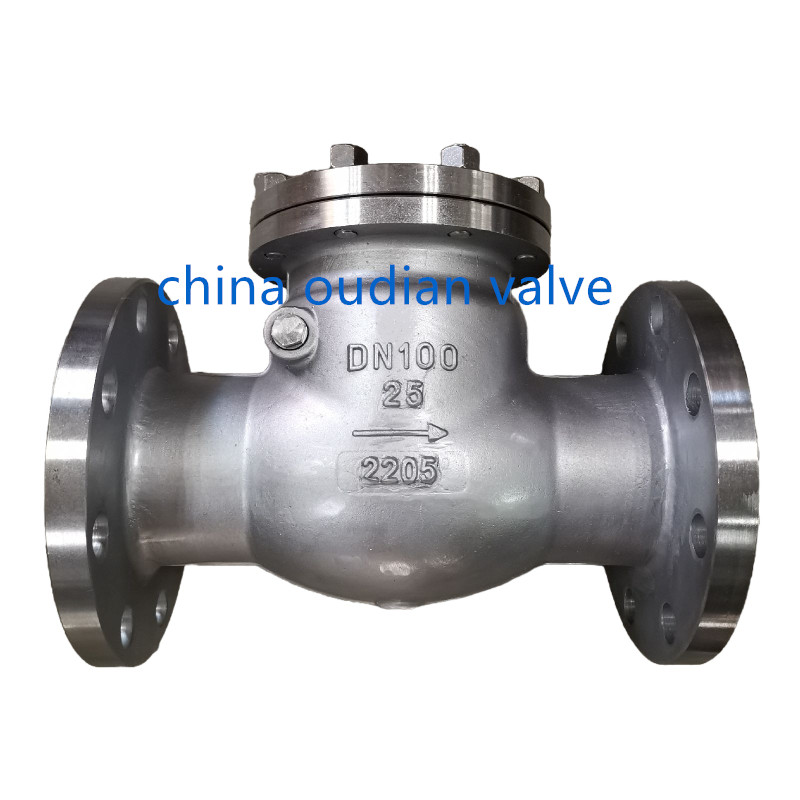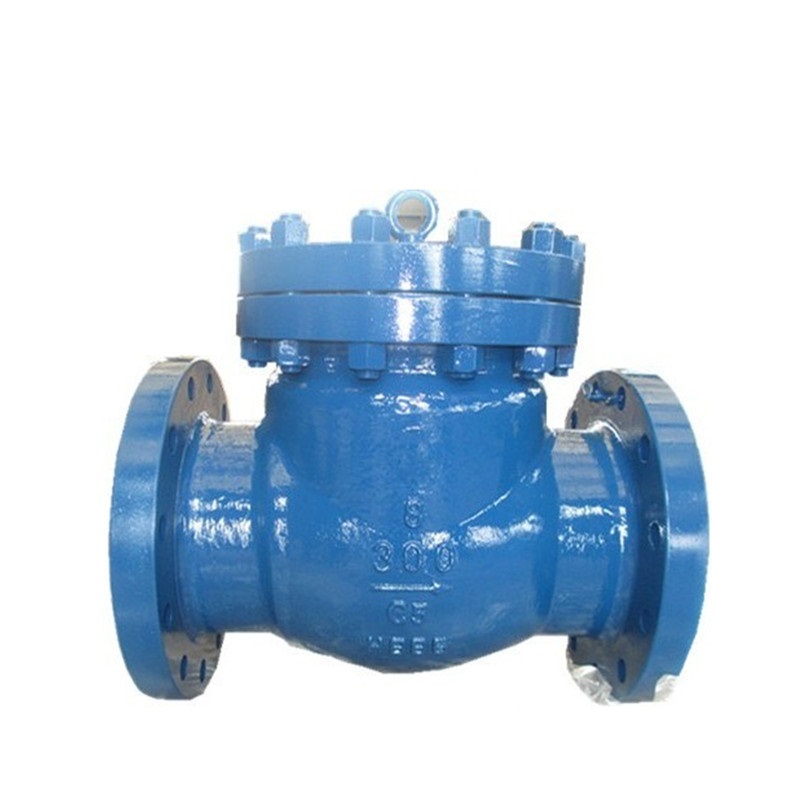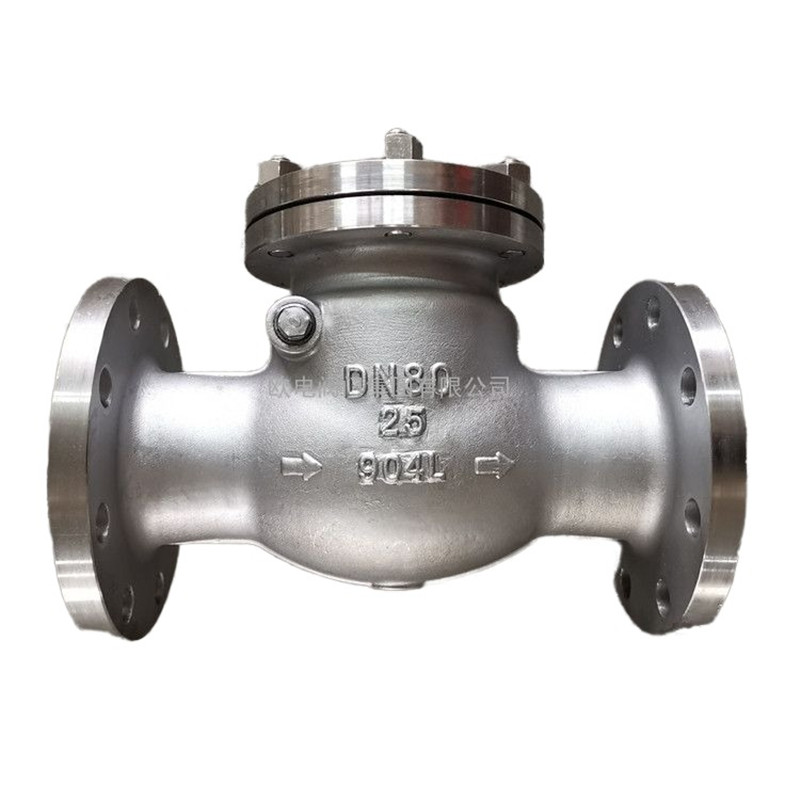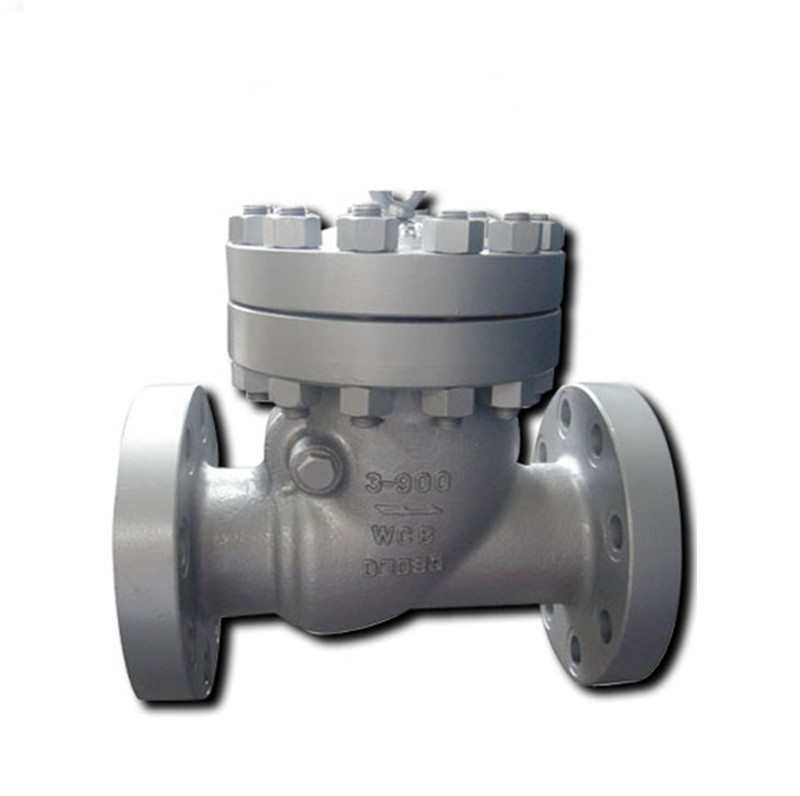


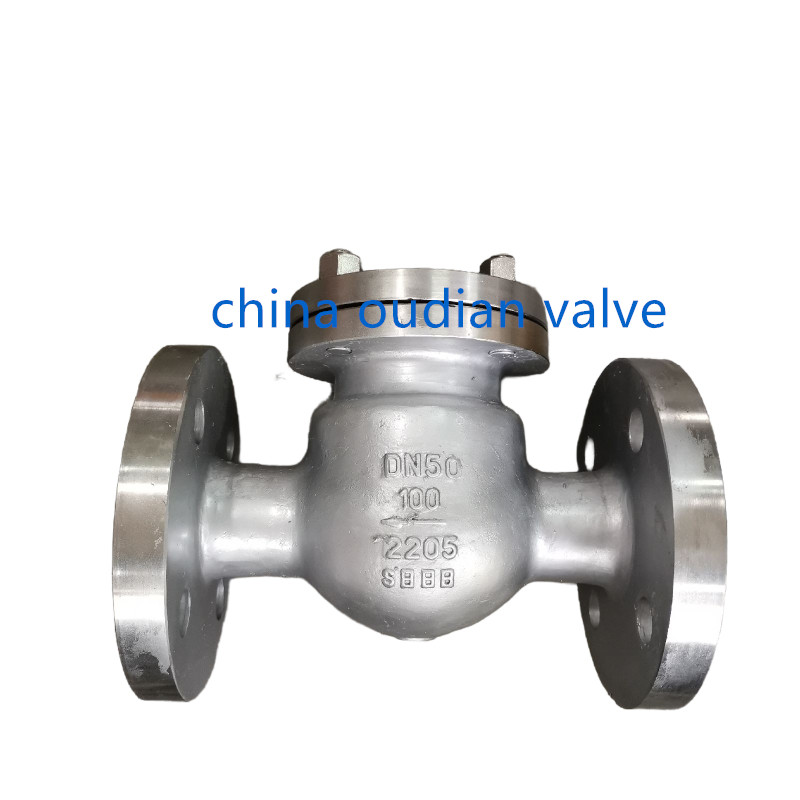
Valvola di ritegno PN100 2205, DN50, estremità RF
China 2205 Check Valve, PN100 2205 Check Valve,DN50 2205 Check Valve,RF End 2205 Check Valve,2205 Check Valve Factory
PN100 2205 Check Valve
Material: 2205 Duplex Stainless Steel
- Standard: UNS S32205, EN 1.4462, ASTM A182 F51 / A351 CD4MCU
- Composition: Cr 22%, Ni 5%, Mo 3%, N 0.14–0.20% — dual‑phase microstructure (50% austenite + 50% ferrite)
- Core Advantages:
High Strength: Yield strength ≥ 450 MPa — 2× stronger than 316L → thinner wall, compact design, safe for PN100 high pressure
Superior Corrosion Resistance: PREN ≈ 35–38 — far better pitting & crevice resistance than 316L/317L; excellent in chlorides, seawater, brine, brackish water, H₂S/sour service, dilute acids
Stress Corrosion Cracking (SCC) Resistance: Highly resistant to chloride & sulfide SCC — main reason for choosing over 316L
Intervallo di temperatura: ‑50°C ~ +300°C; avoid >320°C (risk of embrittlement)
- Limit: Not suitable for strong reducing acids (pure HCl, dilute H₂SO₄ <70°C) or concentrated oxidizing media; avoid <‑50°C (low‑toughness risk)
Full Specifications
Basic Data
- Model:
- H41W‑100 2205: Lift‑type check valve (flanged, vertical/horizontal)
- H44W‑100 2205: Swing‑type check valve
- H42W‑100 2205: Axial flow / Piston / Spring‑loaded check valve (best for high pressure PN100)
- H45W: Y‑type check valve
- Pressione nominale: PN100 (100 bar / 10.0 MPa) — heavy‑duty high‑pressure class
- Size: DN15 – DN300 (½″ – 12″); PN100 available up to DN200 as standard
- Standard di progettazione:
- DIN 3356, EN 12516, API 6D, ASME B16.34, GB/T 12236
- Face‑to‑Face: DIN 3202, ASME B16.10
- Flange: DIN 2543–2545, EN 1092‑1, ASME B16.5 (PN100 = thick‑wall, high‑strength flanges, RTJ/RF face)
- Test Standard: API 598, EN 12266‑1, ISO 5208
- Shell test: 150 bar; Seat test: 110 bar; Leakage Rate A (zero leakage)
Standard Material BOM
| Part | Materiale | Note |
|---|---|---|
| Body / Bonnet / Cover | 2205 Duplex (S32205 / 1.4462) | Forged preferred for PN100; cast CD4MCU available for larger sizes |
| Disc / Gate / Piston / Seat | 2205 | Solid; Stellite 6 hardface optional for high‑wear / high‑velocity service |
| Spring | Alloy C‑276 / X‑750 / 2507 | 316L spring will fail rapidly — high pressure + corrosion |
| Gasket | Spiral‑wound: 2205 winding + graphite filler or solid 2205 gasket | Never use 316L — galvanic risk |
| Seal / O‑Ring | PTFE, Graphite, Kalrez® (FFKM) | ≤ 200°C: PTFE; > 200°C: Graphite/metal |
| Fasteners | 2205 / 2507 / Alloy 718 | Carbon steel / 304/316 forbidden |
| Pin / Shaft / Trunnion | 2205 or 2507 | Anti‑galling, high strength |
Key Advantages for PN100 Service
- High Pressure + Corrosion Resistance Combined:
- PN100 requires very high material strength — 2205 delivers this while resisting corrosion that carbon steel or 316L cannot handle
- Perfect for high‑pressure pipelines with chlorides, brine, or sour gas
- Compact & Lightweight:
- Higher strength means thinner wall thickness vs 316L/904L → smaller footprint, easier installation, lower weight
- Fast & Reliable Non‑Return:
- Spring‑loaded / axial‑flow design preferred for PN100: closes instantly, minimizes water hammer
- Bidirectional sealing capability; zero reverse leakage
- Cost‑Performance Leader:
- ~60–80% more expensive than 316L, but 1/2 to 1/3 the cost of 2507 / C4 / Titanium
- Best balance of strength, corrosion resistance, and price for high‑pressure chloride service
Recommended Valve Type for PN100
- Axial Flow / Piston / Spring‑Loaded (H42W) — TOP CHOICE:
- Compact, short face‑to‑face, suitable for any installation position
- Spring‑assisted closing → very low pressure drop, fast response, minimal water hammer
- Best for high pressure, high velocity, gas/liquid mixed service
- Lift‑Type (H41W): Good, but higher pressure drop; best for horizontal lines
- Swing‑Type (H44W): Not ideal for PN100 — bulky, slow closing, heavy, high torque; use only for large DN low‑velocity
Comparison: 2205 vs 316L / 904L / 2507 / TA2 (PN100 Rating)
| Parametro | 316L | 904L | 2205 | 2507 | TA2 |
|---|---|---|---|---|---|
| Strength (Yield) | 170 MPa | 215 MPa | 450 MPa | 550 MPa | 275 MPa |
| PN100 Suitability | Too weak | Too weak | Eccellente | Best | Needs special design |
| Chloride Resistance | Povero | Bene | Very Good | Eccellente | Eccellente |
| Sour Service (H₂S) | Fail | Limitato | Bene | Eccellente | Fail |
| Reducing Acids | Povero | Eccellente | Fair | Fair | Fail |
| Relative Cost | 1.0x | 3.0x | 2.2x | 4.0x | 5.0x |
| Best For PN100 | — | — | Standard choice | Severe corrosion | — |
Rule:High pressure (≥ PN63) + chloride / seawater / sour gas → 2205 is default selection; upgrade to 2507 only if chloride > 10,000 ppm or extreme corrosion
Installation & Operation Rules
- Flow Direction: Arrow marked on body — install strictly in flow direction
- Orientation:
- Spring‑loaded / Axial: Any orientation (horizontal/vertical)
- Swing‑type: Install only horizontal, pin axis horizontal
- Galvanic Isolation: 2205 is noble alloy. Do NOT connect directly to carbon steel. Use insulating gaskets or 2205 spool pieces.
- Welding: Use filler ER2205 / 1.4462; controlled heat input (10–25 kJ/cm); interpass temp < 150°C; NO post‑weld heat treatment needed
- Temperatura: ≤ 300°C continuous; above this, strength drops and embrittlement risk increases
- Avoid: Media containing hydrofluoric acid, pure hydrochloric acid, or strong reducing acids
FAQ: PN100 2205 Check Valve
A: 316L yield strength is only 170 MPa — to reach PN100 it would need extremely thick walls (heavy, expensive, still low corrosion resistance). 2205 = 2× strength + far better corrosion → perfect match for PN100.
A: In most cases YES. 2205 covers 80% of duplex applications at ~55% cost of 2507. Upgrade to 2507 only if: chloride > 15,000 ppm, high‑temperature brine, or extreme sour service.
A: Standard: DN15 – DN200. DN250–DN300 PN100 is custom forged, available but higher cost.
A: In high‑pressure seawater/brine: 10–15 years; 3–4× longer than 316L.
PN100 2205 Check Valve is the standard industry solution for high‑pressure corrosion service. It offers the optimal mix of strength, corrosion resistance, availability, and economy — exactly what you need for pipelines where pressure is high and stainless steel would corrode.