



Mini Ball Valve Selection and Engineering Guide
System operating pressures, fluid chemistry, ambient temperatures, and port geometry govern the choice of valve assembly for any installation. Aligning housing materials with operational media protects internal seals against chemical degradation and mechanical wear.

Core Components and Working Principles of a Mini Ball Valve
A mini ball valve relies on an internal sphere with a center bore that rotates ninety degrees to allow or arrest flow. When the valve handle aligns with the pipe axis, the opening faces directly into the flow stream to permit media movement. Turning the handle perpendicular sweeps the solid curved face of the sphere across the inlet, cutting off the passage.
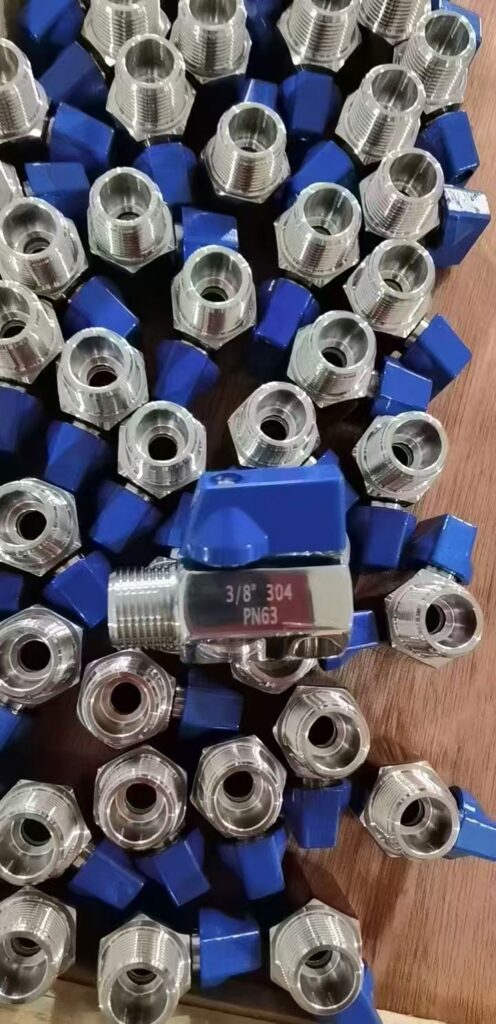
The compact footprint comes from streamlined housing profiles, shorter overall lengths, and low-profile lever or butterfly wing handles. Despite the space-saving proportions, the internal sealing architecture shares the same mechanical logic as full-sized industrial valves.
Body and Stem
The external casing encloses internal components while the stem transfers rotational torque directly from the external handle down to the ball.
Sealing Seats
Polymer seat rings cradle the sphere on both sides to provide tight mechanical sealing and low operating friction during actuation.
Actuation Lever
Low-profile wedge, wing, or flat lever handles allow swift quarter-turn manual operation in narrow enclosures and recessed panels.
Body Materials, Connection Ends, and Pressure Ratings
Material construction dictates operating limits for chemical exposure, thermal range, and line stress. Brass serves reliably in plumbing, pneumatic air lines, and inert gas transfers, whereas stainless steel offers higher chemical resistance and handles corrosive washdowns or aggressive fluids. Connection styles accommodate diverse plumbing configurations, including female-to-female, male-to-female, and compression ends.
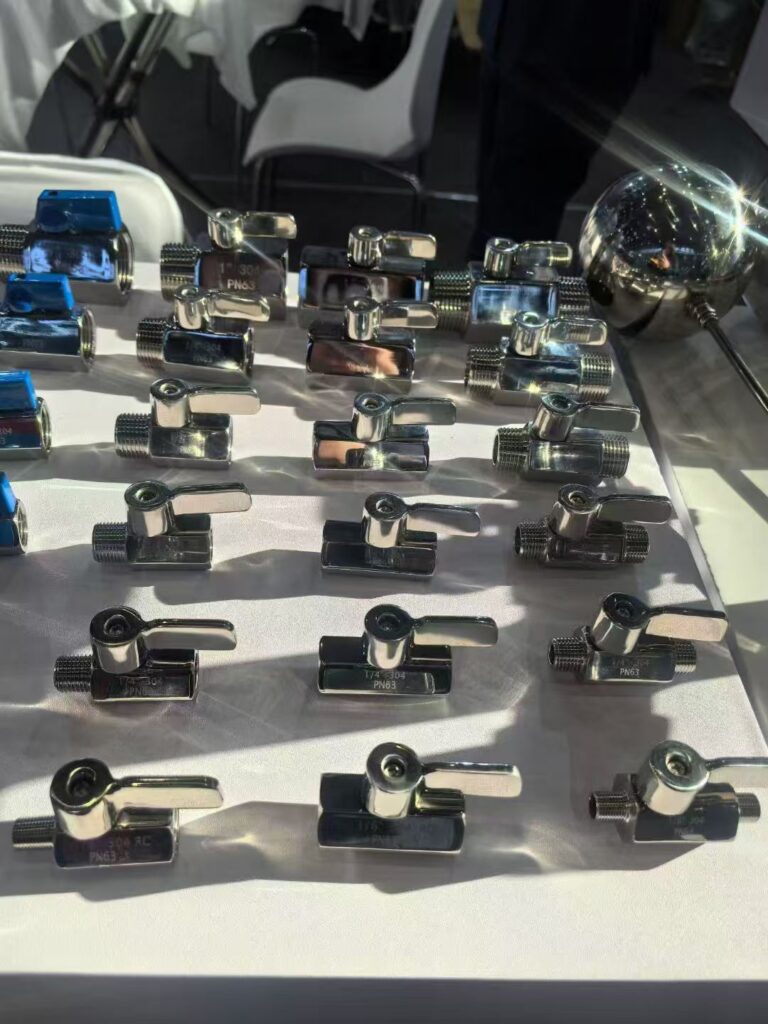
System designers match end connections to the mating pipe threads while reviewing thermal and mechanical loads against rated tolerances. Elastomeric and fluoropolymer seat compositions set the upper boundaries for fluid temperatures and sealing performance.
| Material | Corrosion Level | Primary Media | Typical Application Focus |
| Forged Brass | Moderado | Water, Air, Oils | General shop compressed air, non-potable water, and mechanical drainage lines |
| Nickel Brass | Bien | Mild Fluids | External equipment panels needing surface protection against atmospheric tarnishing |
| 316 Stainless | Alto | Chemicals, Steam | Corrosive chemical injection, marine environments, and food processing systems |
| Acero carbono | Standard | Hydraulic Fluids | High-stress hydraulic fluid circuits and industrial machine lubricant isolation |
Common Applications, Advantages, and System Limitations
Mini ball valves excel in secondary branch isolation, diagnostic test points, gauge isolation, and space-limited instrument panels. The rapid ninety-degree stroke delivers immediate visual verification of port status, which aids troubleshooting during field inspections. However, the compact architecture generally delivers reduced-port geometry, meaning the internal passage diameter sits slightly narrower than nominal pipe size.
Evaluating physical trade-offs helps operators determine whether a mini ball valve, needle valve, or gate valve best supports the target loop. The table of benefits and operational boundaries illustrates primary system considerations.
Ventajas
- Fast quarter-turn manual shut-off enables rapid fluid isolation.
- Compact physical footprint fits cramped instrumentation panels and sub-assemblies.
- Straight-through flow geometry creates lower pressure drops than globe valves.
- Simple mechanical construction requires minimal running upkeep during normal service.
Limitaciones
- Not intended for precise flow metering or sensitive throttling duties.
- Rapid manual cycling can induce hydraulic water hammer in high-velocity liquid lines.
- Reduced internal bore can introduce mild flow restriction in high-volume circuits.
Safe Installation, Operation, and Routine Servicing
Correct installation practices protect threads from galling and prevent stress fractures along the compact valve body. Installers should align pipe segments cleanly before threading components together, using two wrenches to isolate the valve body from excess rotational strain. Thread sealant paste or PTFE tape should be applied with care, leaving the leading thread bare to keep stray particles out of the seating cavity.
Regular maintenance involves checking for external seepage around the packing gland and verifying unobstructed movement of the handle. Adhering to sequential installation steps protects seals and structural integrity.
- Depressurize and vent all connected supply lines completely before placing the valve into the system.
- Inspect internal ports and mating pipe ends to remove loose burrs, metal shavings, and contamination.
- Apply compatible pipe thread sealant to male threads while keeping the leading thread clean.
- Thread the valve by hand, then tighten with an open-end wrench placed exclusively on the hex flat adjacent to the joint.
- Cycle the handle fully open and closed under initial low pressure to verify smooth movement and positive seal contact.
System Selection Criteria and Buying Checklist
Selecting an appropriate mini ball valve demands a complete audit of media chemistry, expected line pressures, thread geometry, and enclosure clearance. Because handles vary between elongated flat levers, thumb-turn butterfly wings, and micro-wedges, the available clearance envelope determines handle ergonomics. Verifying thread compatibility between NPT, BSPP, and BSPT standards prevents joint leakage and premature thread stripping.

Reviewing a structured criteria list assists procurement specialists and equipment builders in identifying the right component configuration before purchasing.
- Fluid Compatibility: Confirm that the body metal and internal seat materials tolerate the operational chemical properties.
- Thread Profile and Gender: Check whether the junction requires male-to-female, female-to-female, or specialized compression joints.
- Pressure Envelope: Select a valve with continuous pressure limits exceeding the maximum transient surges of the line.
- Thermal Boundary: Verify that operating temperatures sit comfortably inside the stated thermal range of the polymer seats.
- Handle Clearance: Choose wing, lever, or thumb handles according to the surrounding spatial limits in the equipment enclosure.
- Bore Dimension: Account for flow reduction caused by reduced-bore ports when designing circuits with strict volume targets.
Frequently Asked Questions About Mini Ball Valves
Can a mini ball valve regulate or throttle fluid flow?
A mini ball valve is designed specifically for full-open or full-closed on-off isolation. Operating the sphere in a partially open position causes fluid velocity to erode the polymer seats and degrades sealing integrity over time.
Are mini ball valves bi-directional?
Standard two-way mini ball valves operate bi-directionally because symmetrical seats seal against the internal sphere from either direction. Certain specialized configurations featuring internal relief vents require alignment with designated flow arrows.
What causes external leakage around the valve handle?
Handle leakage typically stems from worn stem packing seals or thermal expansion loosening the stem nut. Tightening the packing gland slightly or replacing the stem O-ring restores sealing integrity.
How does a mini ball valve differ from a standard ball valve?
A mini ball valve features a substantially smaller exterior body, a lower-profile handle, and reduced face-to-face dimensions. Most mini models utilize reduced-port designs rather than full-port designs to maintain structural strength in minimal dimensions.
Which handle design suits tight enclosures best?
Butterfly or wedge wing handles suit tight enclosures best because they rotate within the circumference of the valve body. Flat lever handles provide higher mechanical leverage but require wider swinging clearance during actuation.
Summary of Mini Ball Valve Integration
A mini ball valve provides dependable, compact fluid control when matched carefully to system pressure, fluid chemistry, and dimensional requirements. Evaluating body metallurgy, connection threads, and handle clearance before installation protects equipment assemblies against leaks and premature maintenance cycles.