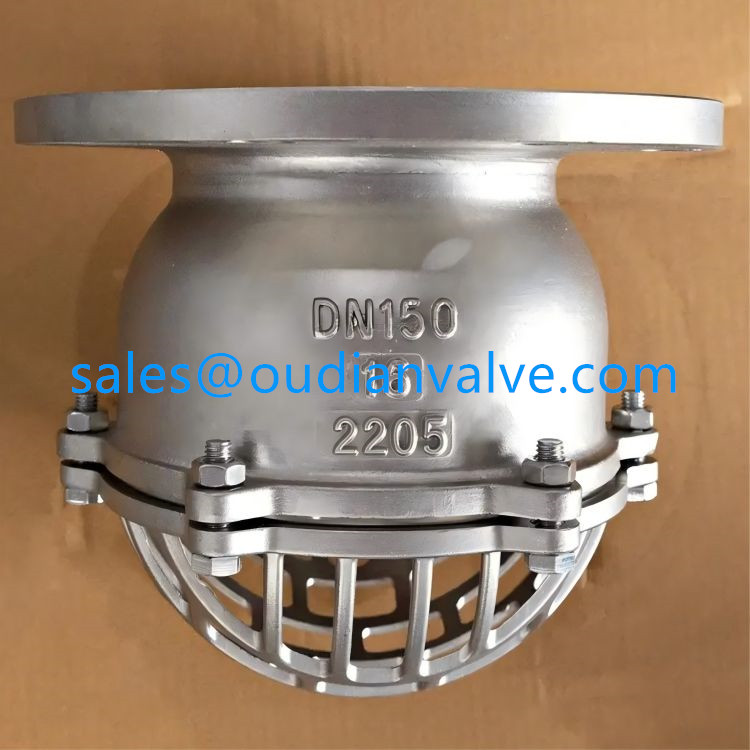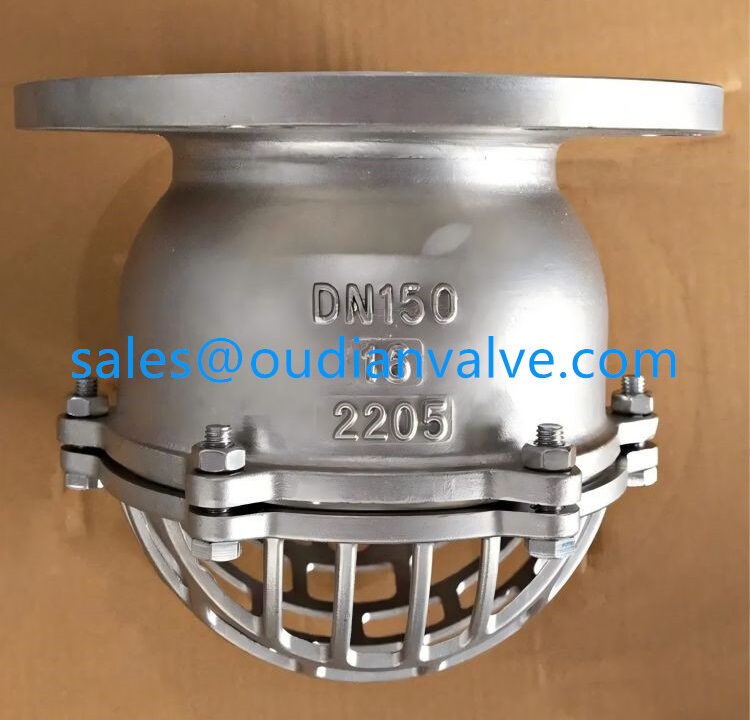
2205 Foot Valve PN16 DN150 Flange End: A Durable Solution for Industrial Pump Systems
Introduction: What Is a 2205 Foot Valve PN16 DN150 Flange End?
A 2205 Foot Valve PN16 DN150 Flange End is a pipeline valve designed for installation at the inlet of a pump suction line. Its primary function is to help maintain liquid in the suction pipeline when the pump stops, reducing the risk of losing prime and supporting reliable pump startup.
Manufactured using duplex stainless steel grade 2205, this type of foot valve can be considered for industrial applications where strength, corrosion resistance, and dependable liquid intake are important.
The designation describes four key product characteristics:
- 2205: Duplex stainless steel material, commonly associated with UNS S32205 or S31803, depending on the specified grade.
- PN16: Nominal pressure designation PN16, subject to the applicable design standard and operating conditions.
- DN150: Nominal diameter of 150 mm.
- Flange End: Flanged connections for installation in a compatible pipeline system.
For industrial buyers, pump manufacturers, EPC contractors, and engineering companies, selecting the right foot valve requires more than confirming its size and pressure rating. Material compatibility, flow capacity, sealing performance, installation conditions, and maintenance requirements must also be considered.
Oudian Valve provides industrial valve solutions for different pipeline and flow-control applications. Buyers requiring a DN150 PN16 duplex stainless steel foot valve should confirm the specific 2205 configuration, dimensions, and technical documentation with Oudian before ordering.
1. Key Specifications of a 2205 Foot Valve PN16 DN150
The following table summarizes the typical specification requirements for this product category.
| Parámetro | Especificación |
|---|---|
| Product Name | 2205 Foot Valve |
| Tamaño nominal | DN150 |
| Pressure Designation | PN16 |
| Material del cuerpo | Duplex Stainless Steel 2205 |
| Common Material Designations | UNS S32205 / S31803, subject to confirmation |
| Conexión final | Con brida |
| Valve Function | Prevents reverse flow and helps retain liquid in the pump suction line |
| Installation Location | Pump suction line inlet |
| Aplicaciones típicas | Water intake, industrial liquid transfer, compatible process systems |
| Flange Standard | To be confirmed according to project requirements |
| Material de sellado | Selected according to the fluid and operating temperature |
| Testing Requirements | To be confirmed according to the applicable product standard |
Technical note: These are reference specifications based on the requested product description, not a verified Oudian product datasheet. The valve construction, pressure rating, flange drilling, face-to-face dimensions, materials, and test standards should be confirmed against the manufacturer’s approved drawings.
PN16 does not automatically establish the allowable operating pressure of every component under all temperatures and service conditions. The applicable rating must be verified for the complete valve assembly.
2. Why Choose Duplex Stainless Steel 2205 for a Foot Valve?
Duplex stainless steel 2205 combines a ferritic-austenitic microstructure with a useful balance of mechanical strength and corrosion resistance. It is often considered for industrial environments where conventional stainless steel grades may not provide the desired performance.
Excellent Resistance to Chloride-Related Corrosion
Duplex 2205 generally offers better resistance to chloride-induced pitting and crevice corrosion than conventional 304 and 316 stainless steels under comparable conditions.
This makes it a potential material choice for selected seawater-related auxiliary systems, brackish water, and industrial liquids containing chlorides.
However, suitability depends on chloride concentration, temperature, flow conditions, deposits, and other environmental factors. Duplex 2205 is not immune to corrosion and should not be assumed suitable for every seawater application.
High Mechanical Strength
Duplex 2205 typically provides higher yield strength than conventional austenitic stainless steel grades such as 304 and 316. This can be advantageous when designing pressure-containing components that must withstand mechanical loads.
The actual allowable design stresses and pressure rating must still follow the applicable standards and valve design.
Improved Durability in Demanding Environments
A suitable 2205 material specification can help reduce corrosion-related maintenance risks in compatible service conditions.
For a DN150 foot valve, correct material selection is particularly important because the valve is exposed to the incoming liquid, suspended particles, and potentially aggressive water chemistry.
Long-Term Industrial Value
Although duplex stainless steel 2205 may cost more than some conventional stainless steels, its combination of strength and corrosion resistance can provide lifecycle benefits when properly matched to the operating environment.
The total cost of ownership should consider initial purchase price, maintenance requirements, downtime, and expected service life.
3. How Does a DN150 Foot Valve Work?
A foot valve is commonly installed at the submerged end of a pump suction pipe or at the inlet of a liquid intake line.
Most conventional foot valves combine a non-return mechanism with an inlet screen or strainer, although the exact design depends on the selected product.
The operating principle is straightforward.
When the pump starts: The pressure difference generated by the pump opens the valve, allowing liquid to enter the suction pipeline.
When the pump stops: The valve closes to restrict reverse flow, helping retain liquid in the suction line and maintain pump priming.
During liquid intake: An integrated screen, when provided, helps prevent larger debris from entering the pump and damaging internal components.
For a DN150 foot valve, the effective flow area, opening characteristics, and strainer design should be evaluated against the required pump flow rate and allowable suction losses.
A foot valve that is too restrictive can increase suction-side pressure losses and negatively affect pump performance. Correct sizing is therefore essential.
4. Main Applications of a 2205 PN16 DN150 Foot Valve
The 2205 foot valve can be considered for compatible industrial liquid-handling systems where corrosion resistance and suction-line reliability are important.
Water Intake and Pumping Stations
Foot valves are used at the intake end of suction lines in suitable water pumping arrangements. A duplex stainless steel construction may be beneficial when the water chemistry presents a higher corrosion risk.
Marine and Coastal Installations
Certain marine and coastal auxiliary systems handle brackish water or chloride-containing liquids. Duplex 2205 may be appropriate for selected duties, provided the actual exposure conditions and design requirements are verified.
For direct seawater immersion or severe marine service, the suitability of 2205 requires careful engineering assessment.
Procesamiento químico
Industrial plants may use foot valves in compatible chemical transfer systems. Before selecting the material, engineers should verify the chemical composition, concentration, temperature, and potential for localized corrosion.
Industrial Water Circulation
Factories and industrial facilities use pumping systems for process water, utility water, and other compatible liquids. A DN150 PN16 foot valve can be evaluated where the nominal size, pressure class, and flow characteristics meet the system requirements.
Wastewater and Liquid Transfer
Foot valves may be considered for certain wastewater or liquid transfer applications. The presence of solids, fibers, sludge, and debris must be assessed because these materials can obstruct the valve or interfere with sealing.
The final application suitability depends on the specific valve design and the operating medium.
5. Why Consider Oudian Valve for Industrial Valve Sourcing?
Válvula de Oudian is an industrial valve brand offering a range of valve products for pipeline and flow-control applications.
For buyers sourcing a 2205 Foot Valve PN16 DN150 Flange End, direct technical communication with the manufacturer can help establish whether the requested material, connection dimensions, and operating characteristics can be supplied.
When evaluating Oudian or any industrial valve supplier, buyers should consider the following factors.
Material Traceability
Request material test certificates that identify the supplied duplex stainless steel grade and heat number. Confirm whether the required material is UNS S32205, S31803, or another specified grade.
Dimensional Compatibility
For a DN150 PN16 flanged foot valve, verify the flange standard, bolt pattern, facing, installation dimensions, and compatibility with the existing pipeline.
Performance Requirements
Confirm the valve’s opening characteristics, reverse-flow sealing requirements, flow capacity, and strainer arrangement, if applicable.
Quality Inspection
Discuss the applicable inspection and testing standards, material verification, pressure testing, and any third-party inspection requirements.
Project-Specific Support
For EPC projects and industrial procurement, a complete datasheet helps the manufacturer assess the service conditions and identify an appropriate configuration.
Visit the official Oudian Valve website to explore its industrial valve product range:
The availability of this exact 2205 DN150 PN16 flanged foot valve should be confirmed directly with Oudian Valve.
6. How to Select the Right 2205 Foot Valve
Before purchasing a duplex stainless steel foot valve, engineering and procurement teams should evaluate several important technical factors.
Confirm the Exact Material Grade
Specify the required duplex grade and applicable material standard. UNS S32205 and S31803 are related but distinct designations; they should not be treated as automatically interchangeable in every procurement specification.
Verify the Pressure and Temperature Conditions
Confirm the design pressure, maximum operating temperature, minimum temperature, and any transient conditions. Ensure that PN16 is appropriate for the complete valve assembly under the specified service conditions.
Check the Flange Standard
DN150 and PN16 identify nominal size and pressure designation, but they do not independently establish every flange dimension.
Confirm the required flange standard, facing, drilling, gasket arrangement, and mating pipeline flange.
Calculate the Required Flow Rate
The selected valve should provide adequate flow capacity without introducing excessive pressure loss on the suction side.
Pump flow rate, suction pipe diameter, liquid viscosity, strainer open area, and available net positive suction head (NPSH) should all be considered.
Evaluate the Operating Medium
Determine whether the valve will handle freshwater, brackish water, seawater, process chemicals, wastewater, or another liquid. This information is essential for evaluating corrosion resistance and sealing-material compatibility.
Confirm the Non-Return and Strainer Design
Check the valve’s closing mechanism, reverse-flow leakage requirements, debris-handling needs, and cleaning accessibility.
Not every foot valve has the same internal construction, so the design should match the actual application.
7. Installation and Maintenance Recommendations
Correct installation helps a foot valve operate reliably and protects the pump suction system.
- Install at the correct location: Position the foot valve at the suction intake according to the pump and pipeline design.
- Maintain sufficient submergence: Ensure the inlet remains adequately submerged during operation to reduce the risk of air entrainment and vortex formation.
- Check suction-side pressure losses: Verify that the valve and any integrated strainer do not create excessive resistance.
- Inspect the strainer regularly: Remove accumulated debris where a strainer is fitted and cleaning is permitted by the design.
- Verify flange alignment: Use compatible flanges and gaskets, and avoid imposing excessive external loads on the valve.
- Monitor pump performance: Unexpected loss of prime, reduced flow, or abnormal suction pressure may indicate blockage, leakage, or another system issue.
- Follow manufacturer instructions: Apply the approved installation, inspection, and maintenance procedures.
For duplex stainless steel components, suitable fabrication, welding, and repair practices are also important where those processes apply.
8. Frequently Asked Questions About the 2205 Foot Valve PN16 DN150
Q1: What is a 2205 foot valve used for?
A 2205 foot valve is used at the inlet of a pump suction line to permit forward liquid flow and restrict reverse flow when the pump stops. Depending on its design, it may also include a strainer to help protect the pump from larger debris.
Q2: What does DN150 mean?
DN150 is the nominal diameter designation for a 150 mm nominal-size pipeline connection. It does not necessarily mean that the valve’s internal bore measures exactly 150 mm.
Q3: What does PN16 mean on a foot valve?
PN16 is a nominal pressure designation used in relevant piping and valve standards. The actual allowable operating conditions must be determined from the applicable design standard, materials, temperature, and component ratings.
Q4: Why use duplex stainless steel 2205 instead of 316 stainless steel?
Duplex 2205 generally offers higher mechanical strength and improved resistance to chloride-related pitting and crevice corrosion compared with conventional 316 stainless steel under comparable conditions. However, the best material depends on the actual fluid chemistry, temperature, and service environment.
Q5: Is a 2205 foot valve suitable for seawater?
It may be suitable for certain chloride-containing environments, but direct seawater service requires careful assessment. Temperature, stagnant conditions, deposits, crevices, and exposure duration can affect performance. The final material choice should be based on the actual application.
Q6: Is a DN150 PN16 foot valve suitable for every pump?
No. The valve must match the pump’s required flow rate, suction line dimensions, pressure conditions, installation depth, and available NPSH. Excessive suction-side resistance can impair pump performance.
Q7: Can Oudian Valve supply a 2205 Foot Valve PN16 DN150 Flange End?
Contact Oudian Valve to confirm the availability of the exact product, the specified duplex stainless steel grade, the flange standard, the valve construction, and the required inspection documents. These details should be verified before placing an order.
Q8: What information is required for a quotation?
Provide the product name, DN150 size, PN16 designation, exact 2205 material grade, flange standard, fluid type, operating temperature, design pressure, required flow rate, strainer requirements, and destination. A technical drawing or pump datasheet can help clarify the application.
Conclusion: Choose the Right 2205 Foot Valve for Reliable Pump Operation
A 2205 Foot Valve PN16 DN150 Flange End can be an appropriate solution for compatible industrial pumping systems that require reverse-flow prevention, dependable suction-line operation, and enhanced corrosion resistance.
The main selection priorities are the exact duplex stainless steel grade, pressure-temperature suitability, flange compatibility, flow capacity, sealing performance, and maintenance requirements.
Oudian Valve is a potential supplier to contact for industrial valve sourcing and technical evaluation. Before purchasing, confirm the exact model, material certificates, dimensional drawings, performance requirements, and delivery details.
Looking for a 2205 Foot Valve PN16 DN150 Flange End?
Visit https://oudianvalve.com/ to contact Oudian Valve and discuss your project requirements for a suitable industrial foot valve solution.