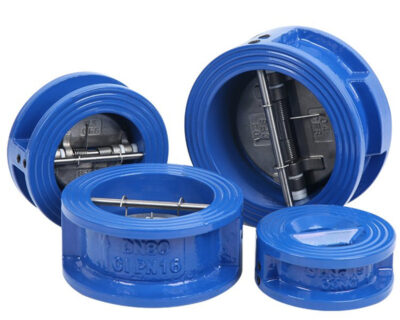


Swing Check Valve vs Spring Check Valve
System designers evaluate line orientation, permissible head loss, fluid cleanliness, and reverse flow acceleration when deciding between these two non-return designs. Selecting the incorrect valve style leads to severe water hammer, excessive pumping costs, premature seat wear, or flow obstruction.
Fundamentals of Non-Return Valves in Piping Systems
válvulas de retención, also designated as non-return or one-way valves, allow fluid flow in only one direction and automatically close to prevent backflow. Unlike manual gate or globe valves, check valves operate entirely without external actuation, relying on line fluid pressure and internal mechanical forces to actuate.
Forward flow creates a differential pressure across the closure member, lifting or swinging it away from the valve seat. When upstream pressure drops or flow reverses, fluid momentum, gravity, or mechanical springs push the closure member back against the seat face. This automatic response protects upstream equipment such as pumps, compressors, and filtration skids from backpressure spikes and contaminating reverse media.
Check valves function as self-actuating safety components that rely entirely on system fluid dynamics and internal geometry to maintain directional process control.
Because check valves react dynamically to process fluctuations, improper selection creates operating instabilities. Flow separation, vortex shedding, and turbulence can cause the internal disc to flutter against its seat or travel stops, accelerating hinge and guide wear.
Operating Principles of Swing Check Valves
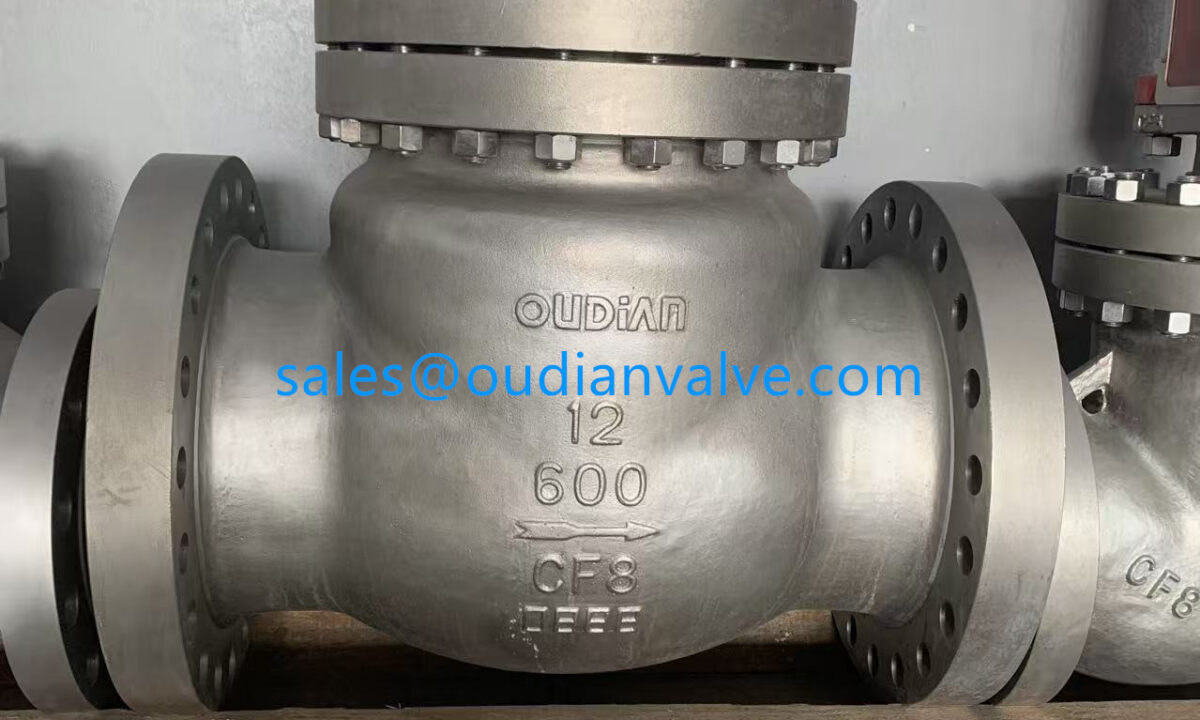
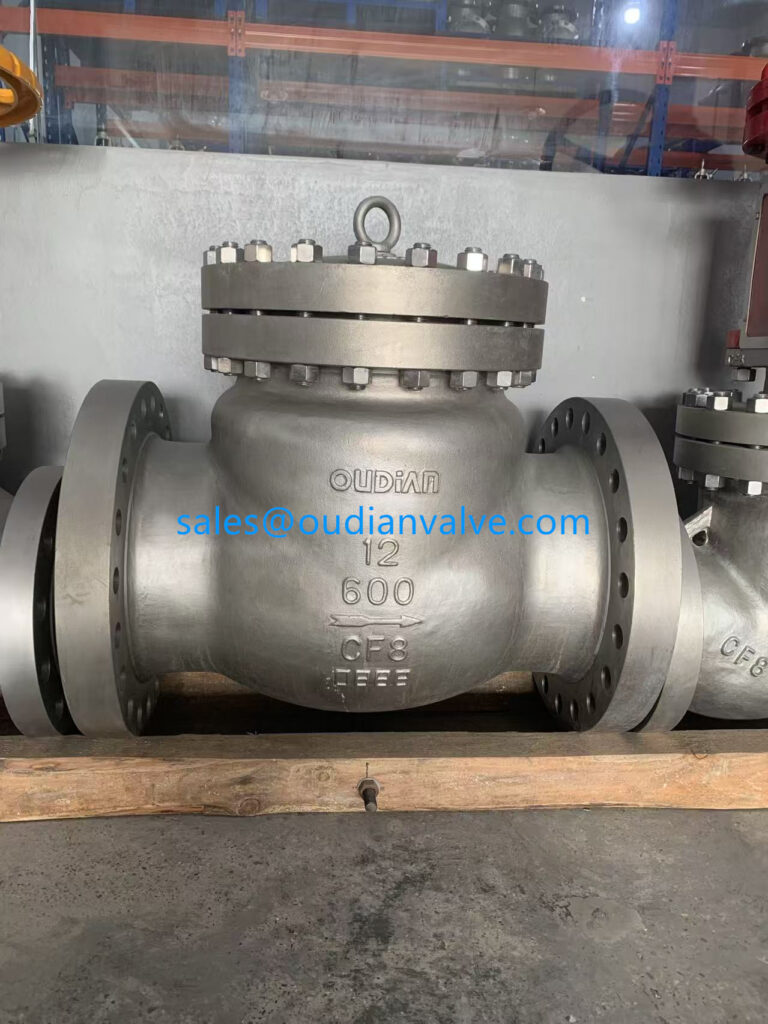
A swing check valve contains a movable disc that pivots around an internal hinge pin located above the flow path. Under forward flow conditions, fluid velocity pushes against the disc face, causing it to swing open into an upper chamber recessed inside the valve body.
When the disc reaches its full open position, the fluid waterway remains largely unobstructed, creating minimal resistance across the valve bore. As upstream velocity decays toward zero, gravity pulls the disc downward along its rotational arc toward the stationary seat ring. Any subsequent backpressure pushes firmly against the backside of the disc, pressing it tighter against the sealing face.
- Forward fluid pressure pushes the disc upward and away from the seat along a circular arc.
- The disc swings into an upper body recess to leave a full-bore flow path for the fluid.
- Gravity and reverse pressure pull and push the disc back onto the body seat ring to arrest reverse flow.
Because closure depends heavily on gravitational pull, swing check valves require careful consideration of piping geometry. In high-velocity lines that shut down abruptly, the disc may take too long to travel through its rotational arc, allowing reverse flow to establish before seat contact occurs.
Operating Principles of Spring Check Valves
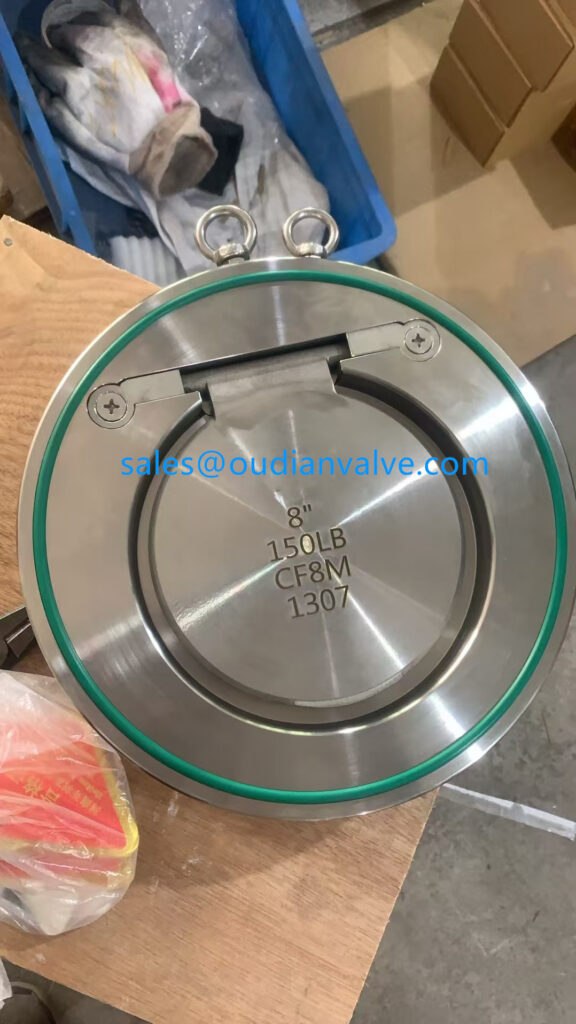
A spring check valve, often referred to as an axial or silent check valve, uses an internal compression spring to assist disc closure. The closure member moves linearly along a central guide stem aligned with the longitudinal axis of the pipe.
Forward flow must generate sufficient hydraulic force to compress the spring and push the disc away from the seat face. The fluid then divides and passes circumferentially around the disc perimeter and through internal guide webs before recombining downstream. Because the spring provides continuous closing bias, the disc begins returning to its seat as soon as forward flow velocity starts decelerating.
Axial Travel Path
The disc moves linearly along a centered guide stem over a very short physical distance, allowing rapid seating response.
Spring-Assisted Closure
A calibrated compression spring forces the disc onto the seat the moment forward flow drops, seating before backflow gathers speed.
This spring-assisted mechanism decouples valve operation from gravitational orientation. The spring provides uniform seating force regardless of whether the valve sits in horizontal, angled, or vertical piping runs. The immediate closure behavior prevents reverse fluid momentum from building up against the disc.
Mechanical Design and Internal Components
The mechanical architecture of swing check valves and spring check valves differs substantially in travel distance, moving parts, and internal flow passage geometry. These structural differences dictate how each valve interacts with line turbulence, suspended solids, and pressure variations.
Swing check valves feature an asymmetrical body design with a bolted or threaded bonnet covering an internal pivot arm and hinge pin. The disc moves along a wide rotational arc, meaning the distance traveled from fully open to fully closed is relatively long. The internal volume of the valve body is enlarged to allow the disc to swing clear of the fluid stream without catching on the ceiling of the waterway.
Spring check valves possess a symmetrical, compact body with an internal spider guide, a central stem, and a coiled or disc-style spring. The linear stroke distance of a spring check valve is significantly shorter than the swing arc of a comparable swing check valve. This minimal disc travel allows the closing mechanism to travel from full lift to seat contact in fractions of a second.
The short linear stroke of a spring check valve enables rapid closure, whereas the longer rotational path of a swing check valve provides an open, unhindered waterway.
Sealing interfaces also diverge based on internal construction. Swing check valves often utilize metal-to-metal seating faces or resilient elastomer inserts pressed into the disc face, whereas spring check valves frequently use flat elastomer O-rings, disc seals, or precision-machined metal conical seats.
Flow Capacity and Pressure Drop Considerations
Pressure drop across a check valve represents energy lost through friction, direction changes, and contraction of the fluid stream. The internal geometry of the valve directly governs its flow coefficient and overall pumping efficiency.
Swing check valves excel in low pressure drop performance because the disc swings out of the primary flow cross-section. When operating under design velocity, fluid passes through a smooth, full-port opening that matches the internal diameter of the adjacent pipe. Consequently, swing check valves exhibit high flow coefficients and minimal flow resistance, making them ideal for high-volume gravity flows or low-head pumping systems.
- Swing check valves offer a full waterway that minimizes permanent pressure loss in high-flow pipelines.
- Spring check valves split the flow stream around a central disc and guide ribs, generating measurable drag.
- The continuous force needed to hold a spring check valve open creates an unavoidable ongoing pressure drop.
- Sizing valves according to actual flow rate rather than nominal pipe size prevents partial-lift flow instabilities.
Spring check valves introduce higher resistance because the disc, stem guide, and spring assembly remain centered inside the flow passage. Fluid must split around the disc obstruction, resulting in localized velocity increases, turbulence, and permanent head loss. Additionally, fluid energy is continuously consumed keeping the spring compressed during operation.
Cracking Pressure and Low-Pressure Sealing Behavior
Cracking pressure represents the minimum upstream differential pressure required to initiate disc lift and achieve forward flow through the valve. Understanding this threshold is critical for low-pressure, gravity-fed, and sensitive dosing networks.
Swing check valves feature a very low cracking pressure because they have no spring pre-load resistance to overcome. Forward fluid need only overcome the weight of the disc and the negligible friction of the hinge pin bearing. However, this same characteristic means that swing check valves require a distinct reverse differential pressure or a significant static head to establish a leak-tight seal against the seat.
Spring check valves require forward fluid to overcome the pre-loaded force of the mechanical spring before any flow can pass. Springs are selected with specific cracking pressure ratings depending on process requirements, ranging from very light spring rates to stiff resistance options. If system supply pressure falls below the spring rating, the valve remains firmly closed regardless of upstream fluid presence.
In low-pressure gravity systems, installing a spring check valve with an excessive spring rating can completely choke forward flow or create severe throttling across the seat.
For low-pressure gas, vacuum lines, or light hydrostatic head conditions, the spring force provides positive mechanical sealing even without backpressure. This makes spring check valves superior for applications where fluid cannot produce enough backpressure to seal a loose swing disc.
Mounting Orientations and Piping Layout Requirements
Piping layout geometry frequently determines whether a swing check valve or a spring check valve can be deployed safely. Valve orientation influences internal disc positioning, wear patterns, and closure reliability.
Standard swing check valves operate reliably in horizontal pipe runs where gravity assists the downward swing of the disc toward the seat. They can also function in vertical pipelines, but only when fluid flows vertically upward. In vertical upward lines, forward flow pushes the disc up, and gravity plus fluid weight returns it toward the seat upon flow cessation.
- Verify pipeline flow direction and inclination angle before selecting the valve style.
- Avoid installing standard swing check valves in vertical downward flow lines, where gravity pulls the disc open.
- Maintain recommended straight pipe diameters upstream of swing check valves to mitigate turbulent disc flutter.
- Deploy spring check valves freely in vertical down, vertical up, angled, or horizontal pipe orientations.
Swing check valves must never be installed in vertical lines with downward flow. In downward flow orientations, gravity continuously pulls the disc away from the seat, keeping the valve open even during backflow conditions until reverse velocities reach destructive levels.

Spring check valves eliminate orientation limitations because mechanical spring force governs closure rather than gravity. They operate consistently in horizontal lines, vertical upward lines, vertical downward lines, and angled runs. This omnidirectional capability provides flexibility in tight mechanical rooms, skid packages, and modular piping assemblies.
Water Hammer Prevention and Dynamic Closure Speed
Water hammer is a hydraulic pressure surge that occurs when a moving fluid column undergoes a sudden change in momentum, typically caused by rapid pump shutdown or valve closure. This surge produces loud knocking, mechanical vibration, and localized pressure spikes capable of rupturing pipes, damaging instrumentation, and pulling pipe hangers.
Valve slamming occurs when a check valve fails to close before reverse flow velocity reaches a substantial value. In standard swing check valves, the disc must travel through an extensive arc to reach the seat. During pump trip, the decelerating forward column quickly halts and reverses direction before the swing disc completes its downward travel. The incoming reverse flow slams the disc against the seat face, generating an intense shock wave.
Swing Check Slam Risk
The wide swing arc delays seat contact, allowing reverse flow velocity to accelerate before slamming the disc shut violently.
Spring Check Rapid Shutoff
The spring begins seating the disc during deceleration, closing the valve prior to fluid reversal to prevent shock waves.
Spring check valves are specifically engineered to mitigate water hammer by minimizing closure delay. Because the spring continuously pushes the disc toward the seat as forward velocity declines, the disc lands on the seat ring almost exactly when flow velocity reaches zero. By closing prior to the establishment of reverse velocity, spring check valves prevent the conditions that create destructive slam.

Pros and Cons of Each Valve Design
Each check valve design possesses clear operational advantages along with inherent mechanical limitations. Weighing these attributes against system priorities ensures reliable plant operation.
Swing check valves provide unrestricted passage for viscous media and solid-bearing liquids. However, their sensitivity to orientation and vulnerability to hydraulic shock limit their utility in dynamic pumping networks.
Advantages of Swing Check Valves
- Low pressure drop and superior flow coefficient across full line sizes.
- Clear, full-bore waterway that accommodates slurries, wastewater, and suspended solids.
- Top bonnet access facilitates internal inspection without unbolting the valve from the pipe.
- Low initial acquisition cost in medium to large diameter pipe schedules.
Limitations of Swing Check Valves
- Prone to violent valve slam and water hammer under rapid pump shutdown.
- Restricted to horizontal runs and vertical upward flow lines only.
- Disc flutter during low-velocity operation causes premature hinge pin wear.
- Requires a larger physical footprint to accommodate the bonnet and swing chamber.
Spring check valves provide silent, rapid shutoff across compact, multi-directional installations. Their design trade-offs involve ongoing energy losses due to pressure drop and an internal geometry that can trap stringy or particulate debris.
Advantages of Spring Check Valves
- Rapid spring-assisted closure prevents water hammer and pressure surges.
- Can be mounted in any orientation, including vertical downward flow runs.
- Compact wafer or short face-to-face body profiles save valuable layout space.
- Positive spring pre-load maintains tight shutoff even under low backpressure.
Limitations of Spring Check Valves
- Higher continuous pressure drop due to the central disc, guide, and spring resistance.
- Internal guides and springs can foul or clog in slurry, wastewater, or dirty fluids.
- Spring fatigue and corrosion can alter cracking pressure over continuous cycling.
- Often requires removal from the pipeline spool to inspect or replace internal parts.
Maintenance Needs, Inspection, and Durability
The longevity and maintenance complexity of check valves depend on internal component exposure, cycling rates, and mechanical wear mechanisms. Routine maintenance protocols differ considerably between swinging and spring-loaded assemblies.
Swing check valves contain few moving components, comprising mainly the disc, pivot arm, and hinge pin. Primary wear locations include the hinge pin bushings, which experience mechanical friction during flow turbulence and disc oscillation. When operating below minimum velocity requirements, the disc flutters continuously, causing oblong wear on the hinge pin and eventual disc misalignment.
Swing Valve Servicing
Removable top bonnets allow technicians to replace worn discs, hinge pins, and seat rings while the valve body remains flanged directly in the piping spool.
Spring Valve Servicing
Spring check maintenance requires checking spring elasticity, guide bushing clearance, and seat elastomeric integrity, typically requiring spool disassembly.
Spring check valves experience mechanical wear concentrated on the center guide stem and the compression spring. In corrosive or scaling fluids, the spring wire may suffer from stress corrosion cracking, fatigue, or particulate scale buildup that restricts movement. Furthermore, guide bushing clearance can become compromised if abrasive particulates become trapped between the sliding stem and guide bore.

Industrial and Commercial Piping Applications
Matching valve geometry to service conditions determines overall plant reliability. Swing check valves and spring check valves serve distinct application niches across industrial and municipal sectors.
Swing check valves are predominantly installed in continuous high-flow systems where energy conservation is paramount and fluid velocities remain steady. They are standard in municipal water treatment, bulk fluid transfer pipelines, raw sewage pumping, and low-pressure steam loops. The full-diameter passage allows stringy solids and wastewater slurry to pass without catching on internal springs or guide brackets.
Swing Check Systems
- Municipal wastewater treatment
- Raw sewage and slurry transfer
- Bulk water transmission mains
- Low-pressure industrial steam
- Fire protection supply mains
Spring Check Systems
- Commercial HVAC chilled water
- Boiler feedwater injection lines
- High-pressure booster pumping
- Chemical and solvent dosing skids
- Compressor discharge headers
Spring check valves dominate high-cycle, clean fluid environments and pressurized distribution networks where water hammer represents a severe risk. Typical installations include commercial building HVAC systems, pump discharge lines, boiler feedwater loops, domestic hot water recirculation lines, and industrial compressed air systems. In these setups, silent closure and rapid response protect sensitive downstream components.

Selection Criteria for System Designers
Selecting between a swing check valve and a spring check valve requires a structured evaluation of process parameters. Designers should assess fluid characteristics, flow velocity profiles, layout constraints, and surging risks before finalizing pipe specifications.
When pump shutoff is instantaneous, or when parallel pumps cycle frequently, spring check valves provide necessary surge suppression. If the fluid carries grit, pulp, or heavy biological solids, a swing check valve or specialty ball check valve is required to prevent jamming. If piping must run vertically downward, a spring-assisted check valve is the mandatory choice.
| Parámetro | Swing Check | Spring Check | Design Recommendation |
| Flow Resistance | Muy bajo | Moderado | Use swing valves for high-volume gravity lines. |
| Water Hammer | High Risk | Low Risk | Select spring valves to suppress pump slam. |
| Vertical Down | Not Permitted | Suitable | Spring check is mandatory for downflow. |
| Dirty Fluids | Well Suited | Poor Suited | Choose swing valves for slurry or solids. |
| Space Profile | Large Body | Compact Size | Wafer spring valves suit tight mechanical skids. |
| Cracking Delta | Negligible | Calibrated | Spring valves provide positive seat loading. |
Accurate valve sizing is equally critical as valve style selection. Sizing a check valve strictly based on line size often causes the valve to operate partially open, causing the disc to oscillate and wear out rapidly. The valve must be sized based on minimum normal flow velocity to maintain the closure member in its fully open, stable position during operation.
Preguntas frecuentes
Can a swing check valve be mounted vertically?
Swing check valves can be mounted vertically only when flow travels upward, allowing gravity and backflow to seat the disc. They cannot be installed in vertical lines with downward flow because gravity keeps the disc open and allows reverse flow.
Why do spring check valves prevent water hammer?
Spring check valves prevent water hammer by using an internal spring to force the disc closed before forward flow completely halts. By seating the disc prior to the acceleration of reverse flow, the valve eliminates the sudden slam that generates pressure surges.
Which valve has a higher pressure drop?
Spring check valves produce a higher pressure drop because fluid must overcome spring tension and divert around a centrally located disc and guide assembly. Swing check valves swing clear of the primary waterway, offering a full-port opening with minimal resistance.
Can spring check valves handle wastewater and slurries?
Spring check valves are poorly suited for wastewater or slurries because solids, rags, and grit can accumulate in the spring coils and central guide. Swing check valves or ball check valves are preferred for slurries because they feature an unobstructed flow bore.
What causes a swing check valve to chatter?
A swing check valve chatters when line fluid velocity is insufficient to keep the disc held firmly against its internal open stop. Turbulence and velocity fluctuations cause the disc to swing repeatedly back and forth, accelerating wear on the hinge pin and seat.
How does cracking pressure differ between these two valves?
Swing check valves have an extremely low cracking pressure governed only by the physical weight of the disc and hinge friction. Spring check valves require higher cracking pressure because the fluid must overcome the calibrated pre-load force of the internal spring.
Choosing the Right Check Valve Mechanism
Select a swing check valve when pumping clean or slurry-bearing liquids through horizontal pipelines where low pressure drop and energy conservation are primary objectives. Choose a spring check valve when configuring compact skids, vertical piping runs, or fast-stopping pumping networks that require silent closure and robust water hammer protection. Sizing the valve to system flow velocity rather than nominal pipe diameter preserves seat integrity and maintains reliable non-return operation.