


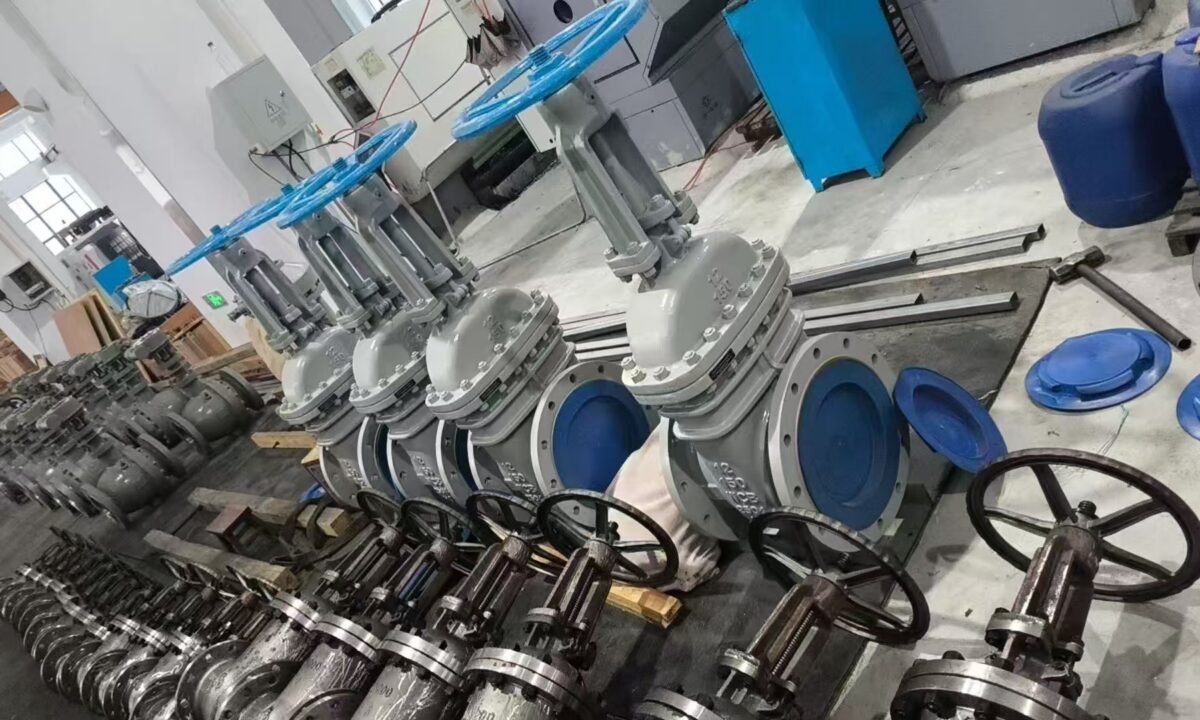
Cast vs Forged Valves
Selecting between these two manufacturing approaches depends on operating pressure, fluid media, thermal cycling, piping size, and maintenance priorities. Evaluating the trade-offs between component cost, structural density, and long-term operating reliability helps plant operators determine the optimal valve construction for each process unit.
Valve Casting Methods and Structural Characteristics
Casting relies on liquid metal taking the shape of a prepared mold cavity to produce complex valve bodies with minimal secondary machining. Liquid steel or specialized alloys fill internal channels, valve seats, and curved outer walls in a single pour, accommodating geometries that are difficult or impossible to forge.
The manufacturing process begins by smelting metal stock until it reaches a fully liquid state. Operators pour the molten metal into refractory molds designed with internal cores to shape the flow path, cooling the metal until it solidifies into a rigid component. After cooling, workers separate the casting from the mold, clean off excess material, and perform surface finishing to satisfy roughness specifications.

Foundries employ different casting approaches depending on component size, required tolerances, and production volume.
Sand Casting
Sand casting serves as the primary method for producing large-diameter valve bodies and heavy structural components. Workers press patterns into specialized sandboxes packed with bonding agents to leave an accurate cavity impression. Once the matching halves bolt together, molten steel pours through top sprues, filling the void before cooling and undergoing shakeout.
Investment Casting
Investment casting produces smaller, highly detailed valve components with refined surface finishes and tight dimensional control. The process utilizes patterns made of wax or lost foam, which technicians coat repeatedly in a wet ceramic slurry to build a rigid outer shell. Heating the ceramic shell to about 1000℃ melts away the residual wax and drives out moisture before molten metal enters the cavity, producing parts weighing up to 100 kg and reaching lengths up to 1.6m.
Casting provides unmatched flexibility for irregular internal geometries and large valve sizes, though technicians must monitor cooling rates to minimize internal shrinkage cavities and microscopic gas porosity.
Valve Forging Techniques and Grain Structure Alignment
Forging shapes ductile metal in a solid state using intense compressive force delivered by industrial presses, hammers, or precision dies. The applied force permanently deforms the workpiece past its yield point without exceeding its ultimate tensile strength, reorganizing the internal grain structure along the contours of the valve body.
Because the metal remains solid throughout shaping, forging eliminates internal shrinkage voids, gas pockets, and cooling cracks that can develop during solidification. The continuous grain flow produced by compressive shaping strengthens critical stress areas, including bonnet neck transitions, mounting flanges, and high-pressure seat pockets.

Forging techniques vary according to working temperature and the physical tooling used to constrain the metal workpiece.
Thermal Classifications
Cold forging shapes metal at room temperature without preheating, requiring immense mechanical pressure and ductile base stock to produce dense, work-hardened components. Warm forging heats metal within the range of 800 to 1000℃ to increase malleability while limiting scale formation on external surfaces. Hot forging heats billets above 1000℃ but below 1300℃, transforming the material into an exceptionally plastic state that allows moderate press pressure to form complex exterior contours.
Die Configurations
Open die forging places the heated billet between flat or simple curved dies without enclosing the material, allowing operators to shape discs, rings, and heavy cylindrical valve bodies through repeated compressions. Closed die forging confines the billet inside precision-machined cavities that capture the entire component shape, delivering tight tolerances and structural consistency across high-volume production runs.
Advantages of Forged Valves
- Continuous grain structure enhances tensile strength and yield properties.
- Absence of internal voids minimizes the likelihood of fatigue cracking.
- Thinner wall profiles tolerate rapid thermal expansion and contraction cycles.
Limitations of Forged Valves
- High tooling and die expenses make low-volume custom runs costly.
- Size limits restrict economical production primarily to smaller pipe diameters.
- Solid-state shaping cannot easily form intricate internal fluid passages.
Mechanical Properties and Operating Reliability
The metallurgical differences between casting and forging directly influence how valve assemblies respond to mechanical stress, thermal shocks, and fluctuating line pressures. Structural density determines whether a valve body can withstand cyclical system pulsations without developing microscopic stress fractures over time.
Forged valve bodies exhibit uniform mechanical properties in the direction of the metal grain flow, which provides superior resistance to mechanical shock and vibration. Cast valve bodies possess isotropic mechanical properties, meaning their strength characteristics remain identical in every direction, which provides predictable load resistance across expansive, asymmetrical valve chambers.
Thermal fatigue resistance represents another critical operational differentiator between these two manufacturing approaches. Forged valves typically feature thinner, denser wall sections that absorb and dissipate heat rapidly, reducing thermal stress gradients during frequent startup and shutdown sequences. Cast valves require thicker walls to compensate for potential material variations, which increases thermal mass and can slow thermal response times in cyclic services.
Cast Valve Characteristics
- Thick walls dampen external vibration
- Isotropic mechanical strength across all axes
- Complex flow cavities reduce flow turbulence
- Economical implementation in large bore sizes
Forged Valve Characteristics
- Directional grain flow resists pressure spikes
- Zero internal gas voids or shrinkage cavities
- Rapid heat dissipation during thermal cycles
- High fatigue limit under severe pulsations
In corrosive environments, surface integrity plays an equally decisive role alongside material grade selection. Non-destructive examination, such as radiography or ultrasonic testing, confirms that cast valves intended for hazardous chemical or offshore service meet strict wall sound standards. Forged valves present fewer internal anomalies, simplifying non-destructive testing routines in critical pipelines.
Cast vs Forged Valves: Direct Application Comparison
Determining the right valve type requires balancing system parameters like pipeline size, pressure ratings, and operating media against procurement budgets. Both designs play vital roles across modern industrial infrastructure when matched to their appropriate operating limits.
The following table outlines the functional performance distinctions between cast and forged valves across critical engineering categories.
| Feature | Cast Valves | Forged Valves | Application Impact |
| Body Density | Moderate | Very High | Forging eliminates gas porosity and internal shrinkage voids. |
| Size Range | Small to Large | Mainly Small | Casting accommodates large diameters without prohibitive tooling costs. |
| Design Shape | Intricate | Moderate | Molds permit complex internal flow passages and curved geometries. |
| Fatigue Limit | Standard | Exceptional | Directional grain flow resists recurring system pressure pulses. |
| Wall Profile | Heavy | Compact | Thinner forged walls cool and heat faster during thermal shifts. |
| Initial Cost | Economical | Moderate | Casting minimizes raw material and machining expenses on large runs. |
| Lead Times | Fast | Variable | Reusable patterns support prompt fabrication of replacement parts. |
General utility services, municipal water lines, low-pressure cooling systems, and large hydrocarbon distribution headers rely heavily on cast gate, globe, and check valves. High-pressure steam lines, offshore injection manifolds, hydraulic control skids, and critical chemical injection lines standardly specify forged construction to minimize leak risks.
Engineering Selection and Purchasing Guidance
Specifying industrial valves requires thorough verification of service conditions, design codes, and ongoing operational costs rather than focusing solely on upfront acquisition pricing. Engineering teams must evaluate how fluid dynamics, piping loads, and maintenance accessibility affect total cost of ownership over the facility lifecycle.
Procurement teams should verify several foundational parameters prior to finalizing a purchase order:
- Operating pressure and temperature ratings to confirm material class compliance.
- Media corrosiveness and particulate loading to determine required metallurgy and wall allowances.
- End connection styles, matching flanged, socket weld, or threaded joints to piping standards.
- Industry standards and quality certifications governing non-destructive examination and material traceability.
- Total ownership cost, balancing initial purchase price against scheduled inspection and repair intervals.
Valve wall thickness and body geometry dictate end connection suitability across different system designs. Forged valves are standardly chosen for small-bore socket weld and threaded connections because their dense microstructure prevents cracking during field welding or high-torque makeup. Large-bore lines favor flanged or butt-weld cast bodies that integrate cleanly into standard piping layouts.
Verify that material test reports and non-destructive examination records match the specific heat numbers stamped on valve bodies before approving field installation.
Total cost calculations should account for operational downtime during maintenance turnarounds. While cast valves offer lower initial procurement costs for mid-to-large sizes, premature failure from fatigue or porosity in severe operating conditions can quickly eliminate initial savings. Investing in forged construction for severe-service manifolds prevents costly unplanned outages.
Frequently Asked Questions About Cast vs Forged Valves
Why are forged valves preferred for high-pressure systems?
Forged valves possess an aligned, uninterrupted grain structure and zero internal porosity, which provides higher yield strength and burst resistance under extreme mechanical loads. Their dense crystalline matrix resists micro-fissuring and cyclic pressure spikes more effectively than cast alternatives.
Can cast valves handle high-temperature industrial service?
Cast valves operate reliably in high-temperature applications when produced from appropriate heat-resistant chrome-moly or stainless steel alloys. However, their thicker walls take longer to adjust to rapid temperature changes, making them best suited for steady-state thermal conditions rather than rapid cycling.
What causes internal porosity in cast valve bodies?
Porosity develops when trapped gases fail to escape molten metal before solidification, or when uneven metal cooling creates localized volumetric shrinkage. Foundries use controlled pouring speeds, specialized sand venting, and feeder risers to reduce the occurrence of these internal voids.
Are forged valves available in large pipe sizes?
Forged valves are rarely manufactured in very large pipe sizes because the immense tonnage of industrial presses and expensive die sets make production economically impractical. Large industrial lines rely predominantly on cast valve bodies to maintain manageable component weights and reasonable manufacturing budgets.
How does lead time compare between cast and forged valves?
Cast valves typically offer shorter procurement lead times for replacement bodies once standard patterns and mold tooling exist at the foundry. Forged valve lead times depend on steel billet availability and specialized die setup, though standard forged small-bore valves remain widely stocked.
Choosing the Right Valve Construction
Selecting between cast and forged valves comes down to evaluating process criticality, line size, pressure levels, and mechanical stress. Cast valves deliver economical, versatile flow solutions for large-diameter and geometrically complex piping, while forged valves provide the dense structural integrity and fatigue resistance demanded by high-pressure, severe-service processes.



