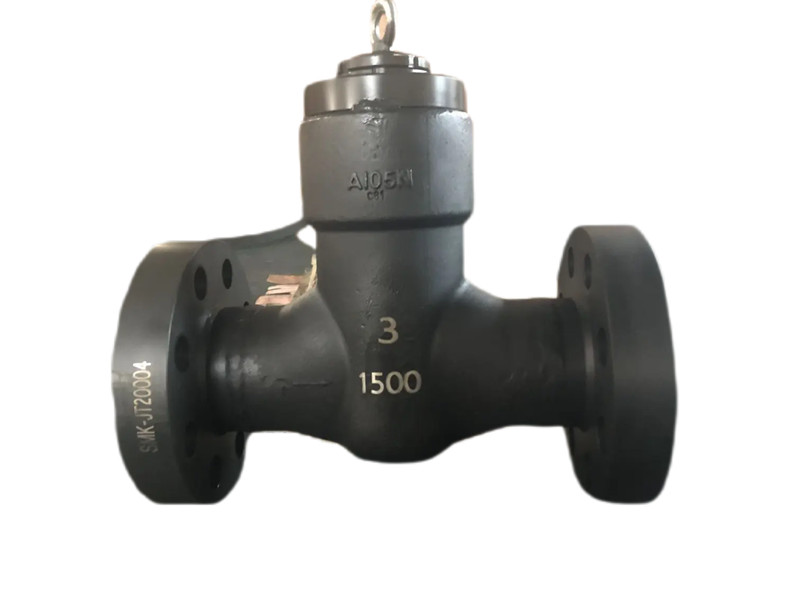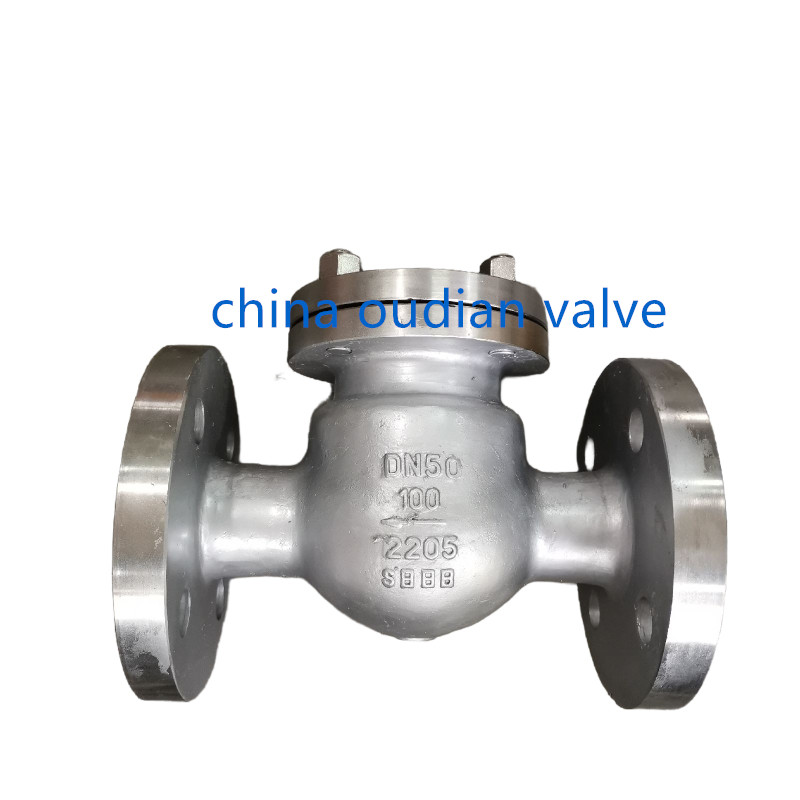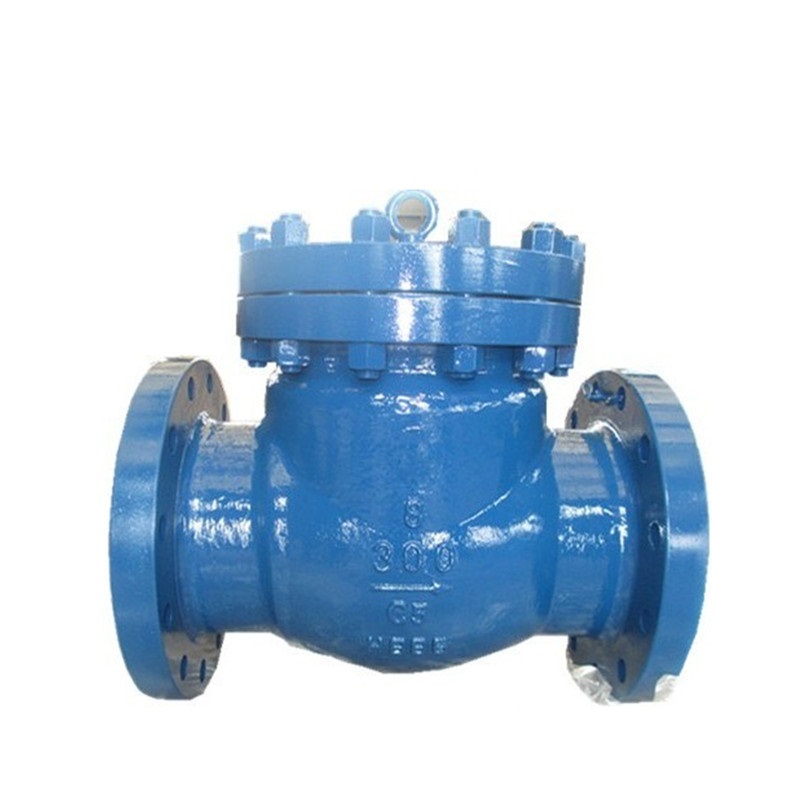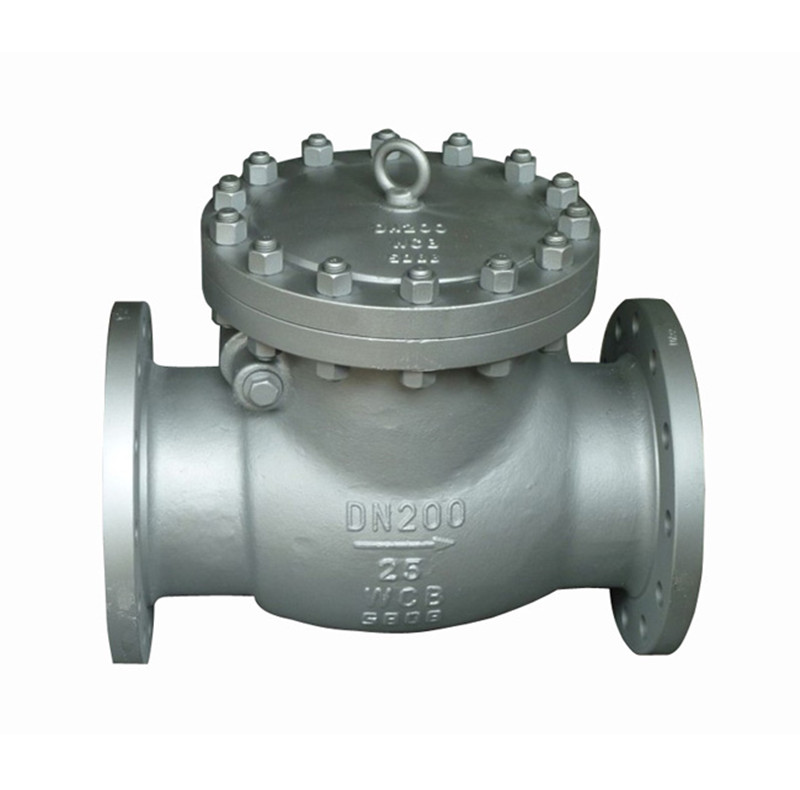


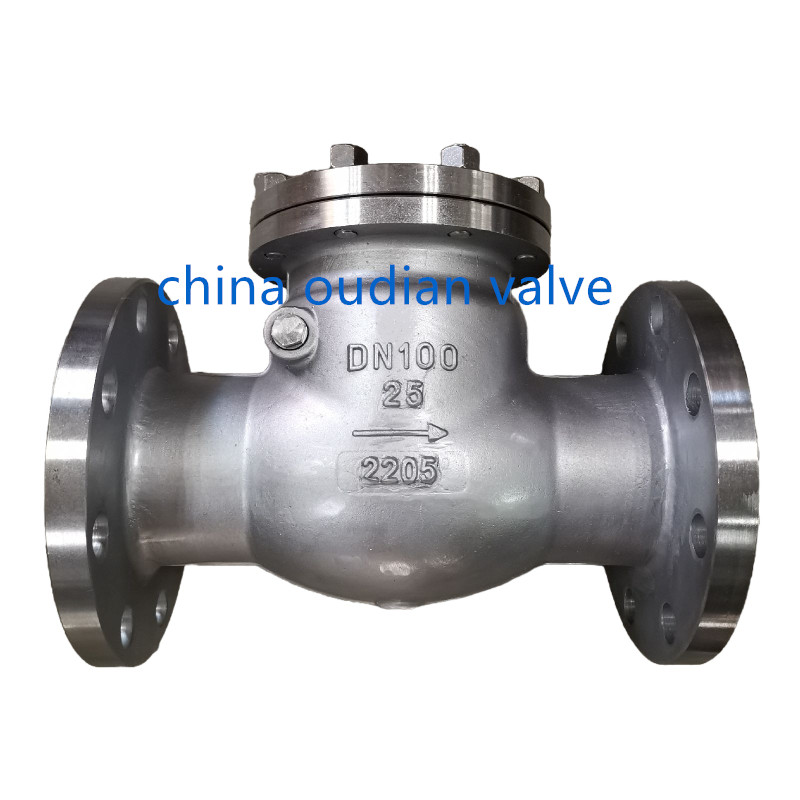
2205 Swing Check Valve,DN100,PN25,Flange End
China 2205 Swing Check Valve,DN100 2205 Swing Check Valve,PN25 2205 Swing Check Valve,Flange End 2205 Swing Check Valve,2205 Swing Check Valve Factory.
O 2205 Swing Check Valve is an automatic non-return valve manufactured from 2205 Duplex Stainless Steel (UNS S31803 / S32205) . This alloy features a dual-phase microstructure consisting of roughly 50% ferrite and 50% austenite, giving the valve twice the mechanical strength and vastly superior corrosion resistance compared to standard 316L stainless steel.
Material Excellence: Why 2205 Duplex?
- High Strength: Allows for thinner, lighter valve bodies that handle equivalent or higher pressures than standard austenitic steels.
- Chloride Resistance: Exceptionally high resistance to Chloride Stress Corrosion Cracking (SCC), pitting, and crevice corrosion.
- Erosion-Corrosion Defense: Highly resistant to mechanical wear from high-velocity fluids containing abrasive sand or particles.
Core Technical Specifications
- Design Standards: Generally built to API 6D, BS 1868, or EN 13709 / DIN 3356 [2].
- Size Range: DN50 to DN600+ (2″ to 24″+) [2].
- Pressure Ratings: ASME Class 150 to Class 2500; PN16 to PN160 [2].
- End Connections: Flanged (RF/RTJ) [2], Butt-Weld (BW), or compact Wafer styles.
- Structure: Typically designed with a Bolted Bonnet (BB) [2] for easy inline seating and hinge pin maintenance.
Primary Industrial Applications
- Oil & Gas Production: Handling sour gas, brackish produced water, and aggressive hydrocarbons.
- Marine & Offshore: Sea water cooling loops, ballast systems, and firewater systems on FPSOs and drilling rigs.
- Chemical & Petrochemical: Processing systems utilizing chlorides, organic acids, and mildly acidic chemical streams.
- Desalination Plants: High-pressure reverse osmosis (RO) feed pumps and brine reject lines.
FAQ: 2205 Swing Check Valve
1. What makes 2205 Duplex steel better than 316 stainless steel for a swing check valve?
2205 Duplex contains higher levels of chromium, molybdenum, and nitrogen. This dual-phase structure gives the valve twice the yield strength of standard 316 stainless steel. It also provides far superior resistance to chloride pitting, crevice corrosion, and Stress Corrosion Cracking (SCC)
2. Can a 2205 swing check valve be used in high-temperature systems?
No, 2205 Duplex has strict temperature limitations. It should not be used above 300°C (572°F) for extended periods. Exceeding this temperature causes the micro-structure to become brittle (known as “475°C embrittlement”), drastically reducing its toughness and impact resistance
3. What is the difference between UNS S31803 and UNS S32205?
Originally, 2205 was specified as UNS S31803. Over time, manufacturers tightened the chemical composition limits (adding more nitrogen and chromium) to maximize corrosion resistance. This optimized version is designated as UNS S32205. Today, most 2205 check valves are dual-certified as both S31803 and S32205.
4. Is a 2205 swing check valve suitable for abrasive slurries?
Yes, very much so. Because of its high mechanical hardness and strength, 2205 Duplex offers excellent resistance to erosion-corrosion. This makes it an ideal choice for pipelines transporting high-velocity fluids that carry abrasive particles, such as sand in oil production or salt crystals in brine solutions.
5. When should I upgrade from 2205 Duplex to Super Duplex 2507 or TA2 Titanium?
You should upgrade if your system operates in highly aggressive, hot chloride environments. While 2205 handles ambient seawater well, Super Duplex 2507 or TA2 Titanium is required if the seawater exceeds 30°C–40°C, or if the fluid contains highly oxidizing acids (like nitric acid) or wet chlorine gas where duplex steels quickly corrode.
6. What standards govern the face-to-face dimensions of this valve?
Depending on your regional requirements, they are governed by:
- ASME B16.10: For Class 150, 300, and 600 flanged valves.
- EN 558 / DIN 3202: For European metric PN16, PN40, or PN100 piping systems