


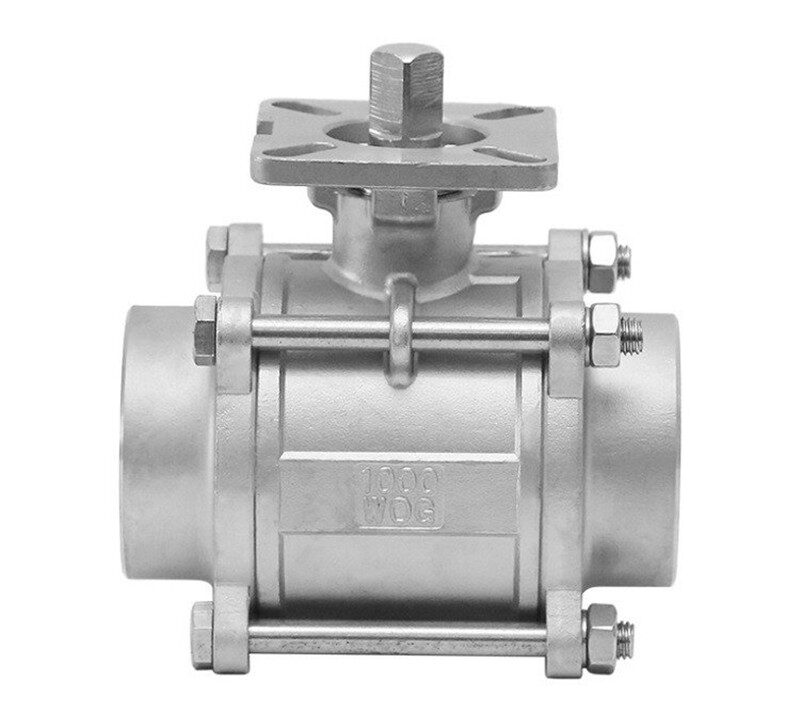
1, 2, and 3-Piece Ball Valves
Operating pressure, line temperature, fluid corrosiveness, and expected maintenance frequency determine which housing style suits a given application. Matching the physical structure of the valve body to the operating environment prevents premature line failures and excessive downtime during maintenance cycles.

Ball Valve Fundamentals and Operating Principles
UN robinet à boisseau sphérique controls fluid movement through a pipe by rotating a bored, spherical disc inside a contoured chamber. When the handle or actuator turns ninety degrees, the hole aligns with the pipeline to permit flow or pivots perpendicular to the stream to establish a tight shutoff.
The interior structure relies on soft or metallic seats pressed against the polished metal sphere to prevent fluid bypass across the closure element. Stem packings and resilient O-rings seal the stem penetration through the valve body, preventing fugitive emissions and external leaks during regular cycling.
- Rotary actuation allows quick quarter-turn operation for rapid isolation or activation.
- Elastomeric or fluoropolymer seats form tight seals against smooth metal balls under line pressure.
- Stem seals isolate process media from the external environment and actuation hardware.
- Valve body castings hold the internal assembly rigid against thermal expansion and line vibration.
The exterior casing must withstand internal hydrostatic stress while providing a rigid housing that keeps the ball aligned with the pipeline axis. How manufacturers construct this external housing determines how technicians install, inspect, and repair the internal seals over the operational life of the system.
One-Piece Ball Valve Design and Characteristics
A one-piece ball valve features an integrated body cast or forged from a single piece of metal. Because the shell contains no body joint seams, the structure minimizes potential external leak paths between housing sections.
Assembly requires inserting the ball, seats, and stem through one end connection before securing them with an internal retaining ring or threaded insert. This manufacturing method requires a ball diameter smaller than the pipe diameter, producing a reduced port that restricts flow volume and introduces a moderate pressure drop across the body.
One-piece bodies eliminate body joint leaks, making them suitable for compact installations where fluid flow demands are modest and valve maintenance is unnecessary.
These units are non-repairable in practice because removing internal seats without damaging the casting threads is difficult and uneconomical. When internal components wear out or begin bypassing fluid, the entire assembly must be cut or unthreaded from the line and replaced with a fresh unit.
Low production costs make single-piece units common in commercial plumbing, domestic water distribution, and low-pressure utility lines where flow restriction does not impede overall system efficiency.
Two-Piece Ball Valve Features and Performance
A two-piece ball valve divides the body into a main section and an end cap connected by threaded or flanged joints. This split construction allows manufacturers to load full-size balls directly into the main cavity before screwing the secondary cap into position.
The two-piece layout supports full port designs where the internal orifice matches the inner diameter of the connected pipe, maintaining unrestricted flow with minimal turbulence. Technicians can unscrew the secondary piece to inspect internal seals, though performing this work requires unthreading the entire valve from the pipeline first.
Avantages
- Full bore fluid passages eliminate flow restriction and reduce pumping losses.
- Moderate purchase cost provides an economical balance between performance and investment.
- Threaded and flanged variants integrate cleanly into diverse piping standards.
Limites
- Internal maintenance requires complete removal from the surrounding pipe run.
- Body joint creates an additional seal interface that requires proper torque to prevent weeping.
- Not practical for permanently welded installations due to thermal seat damage during installation.
Industrial processing facilities and municipal water treatment plants rely heavily on two-piece ball valves for utility isolation. They offer dependable service in air, gas, fuel, and liquid circuits where routine servicing can wait for planned system shutdowns.
Three-Piece Ball Valve Construction and Servicing
A three-piece ball valve consists of an independent central body housing the ball, stem, and seats, sandwiched between two pipe connectors held together by external tie bolts. This modular arrangement separates the plumbing connection from the dynamic sealing components inside the central cavity.
When line servicing is necessary, technicians loosen the exterior bolts and swing or lift the central body out of the pipe run without cutting pipe or unscrewing connections. This capability makes three-piece valves essential in sanitary facilities, chemical plants, and high-cycle industrial lines that demand routine seal replacement or thorough cleaning.
Inline Servicing
Removing tie bolts allows the center section to swing out for seat replacement while pipe connections remain undisturbed.
Welded Connections
End caps can be welded to process lines before the center section is bolted in place, shielding internal elastomer seals from welding heat.
Severe Duty
Heavy exterior bolts and robust bodies withstand line vibration, thermal cycling, and mechanical stress in demanding chemical environments.
The ability to weld end caps directly to tubing without burning delicate internal seats gives three-piece bodies a distinct advantage in high-purity and hazardous processing lines. While the initial equipment cost is higher than one- or two-piece equivalents, the design significantly reduces labor costs during long-term maintenance cycles.
Comparing 1, 2, and 3-Piece Ball Valves Across Key Metrics
Understanding the operational trade-offs of each body construction helps engineers match valve specifications to process parameters. The structural differences dictate initial purchase price, flow characteristics, external leak potential, and long-term serviceability.
| Fonctionnalité | 1-Piece Valve | 2-Piece Valve | 3-Piece Valve |
| Body Construction | Single casting | Two-part split | Center body with bolted end connectors |
| Port Dimensions | Reduced bore | Full bore | Full or standard bore options |
| Serviceability | Non-repairable | Bench rebuildable | Complete inline servicing without pipe removal |
| External Joints | Zero body seams | One seam | Two bolted joint seams with body seals |
| Relative Cost | Lowest upfront | Modéré | Highest initial purchase investment |
| Welded Piping | Not recommended | Not recommended | Ideal for socket weld and butt weld connections |
Single-piece valves minimize purchase outlays on non-critical utility systems where failure simply requires full valve replacement. Conversely, facilities operating continuous processes gain major operational savings from three-piece models because maintenance crews replace worn packing and seats in minutes without disrupting adjacent pipe hangers or equipment connections.
Flow Capacity and Port Configurations
The internal port diameter inside a ball valve governs how easily fluids travel through the system without generating turbulence or unwanted backpressure. Body design dictates whether a manufacturer can integrate a full-diameter flow path or must restrict the channel to fit assembly tolerances.
Full port valves feature a ball orifice identical in diameter to the inside of the matching pipe. Standard and reduced port designs constrict fluid flow through an internal aperture that is smaller than the pipeline, acting as an internal orifice plate.
Full Port Characteristics
- Maintains consistent line velocity and minimal friction loss.
- Enables mechanical pipeline scraping and pigging procedures.
- Requires larger bodies and larger actuator mounting pads.
- Standard configuration on two-piece and three-piece units.
Reduced Port Characteristics
- Creates localized pressure drops and minor fluid turbulence.
- Restricts the passage of mechanical cleaning tools through the pipe.
- Provides compact external dimensions for confined spaces.
- Standard construction pattern for one-piece valve bodies.
Systems carrying viscous liquids, slurries, or high-volume process flows perform best with full port two-piece or three-piece valves to avoid plugging and energy waste from pump head loss. Clean water circuits, compressed air lines, and low-viscosity fuels operate reliably with reduced port one-piece bodies when line capacity margins are generous.
Selecting Ball Valves for Specific Piping Systems
Choosing the correct valve style involves evaluating process chemistry, environmental temperatures, pressure requirements, and maintenance access. Over-specifying valve construction inflates capital costs, while under-specifying leads to premature seal leakage and costly facility downtime.
Facilities handling aggressive chemicals or elevated temperatures benefit from three-piece stainless steel bodies paired with robust fluoropolymer seats. The ability to disassemble the center section allows fast inspection of chemical erosion without cutting welded pipe joints.
Always verify seat and seal chemical compatibility with the process fluid before installation, as thermal expansion and aggressive media degrade elastomeric parts faster than the surrounding metal body.
For standard commercial plumbing and closed HVAC water loops, two-piece brass or bronze valves deliver long-term reliability and full flow capacity at an economical cost. In OEM equipment assemblies and non-critical drain ports where the valve cycles infrequently, one-piece designs provide a compact shutoff mechanism that fits into tight equipment enclosures.
Frequently Asked Questions
Can a one-piece ball valve be repaired when it begins leaking?
One-piece ball valves are generally considered non-repairable because their solid body makes internal seat removal impractical. When internal leakage develops across the ball, replacing the complete valve assembly is the standard procedure.
Why are three-piece ball valves preferred for welded piping systems?
Three-piece ball valves allow technicians to unbolt and remove the center body containing delicate seats and seals before welding the end caps to the pipe. This prevents high welding temperatures from melting or warping the internal sealing materials.
What causes pressure drop across a one-piece ball valve?
Pressure drop occurs because one-piece valves use a reduced port design with a bore diameter smaller than the pipe interior. Fluid speeds up as it passes through the narrowed aperture, creating friction losses and turbulence in the downstream line.
When is a two-piece ball valve better than a three-piece model?
A two-piece ball valve is preferred when a full-port flow path is required but inline servicing is unnecessary. It provides unrestricted flow at a lower purchase price and reduces external joint leak paths compared to a three-piece design.
Summary of Valve Body Selection
Choosing between 1, 2, and 3-piece ball valves comes down to balancing flow capacity, upfront equipment expense, and long-term maintenance access. Evaluating operational pressures, fluid characteristics, and whether the valve requires inline seal replacement allows designers to install the most efficient valve body for their piping architecture.