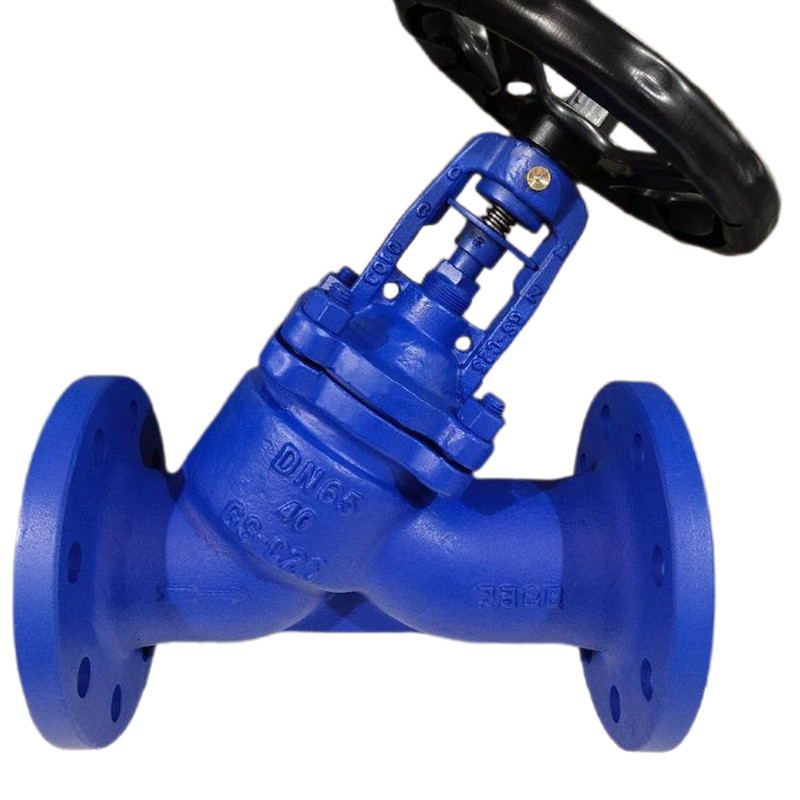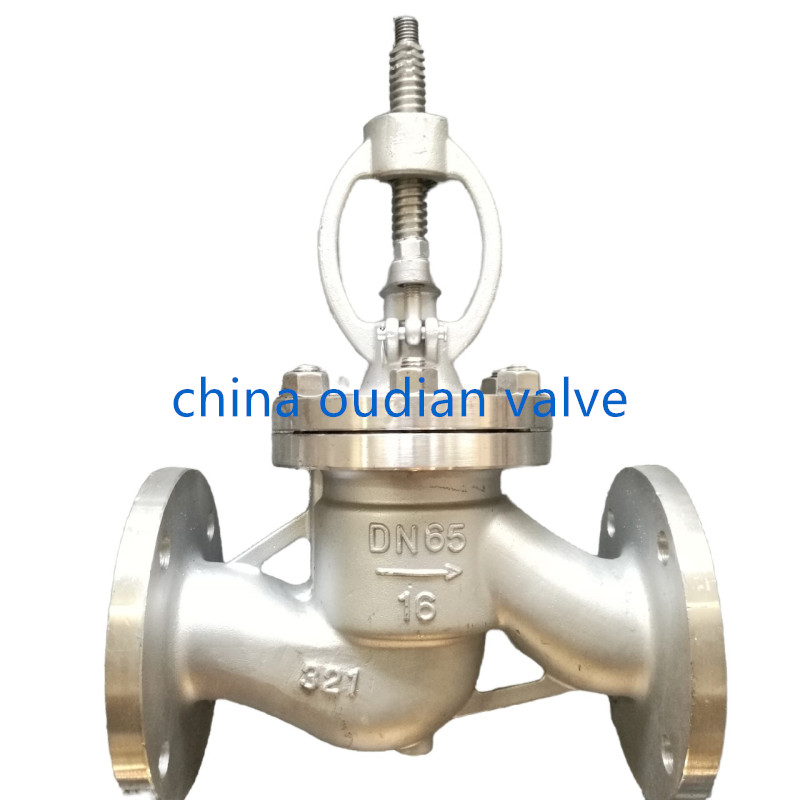


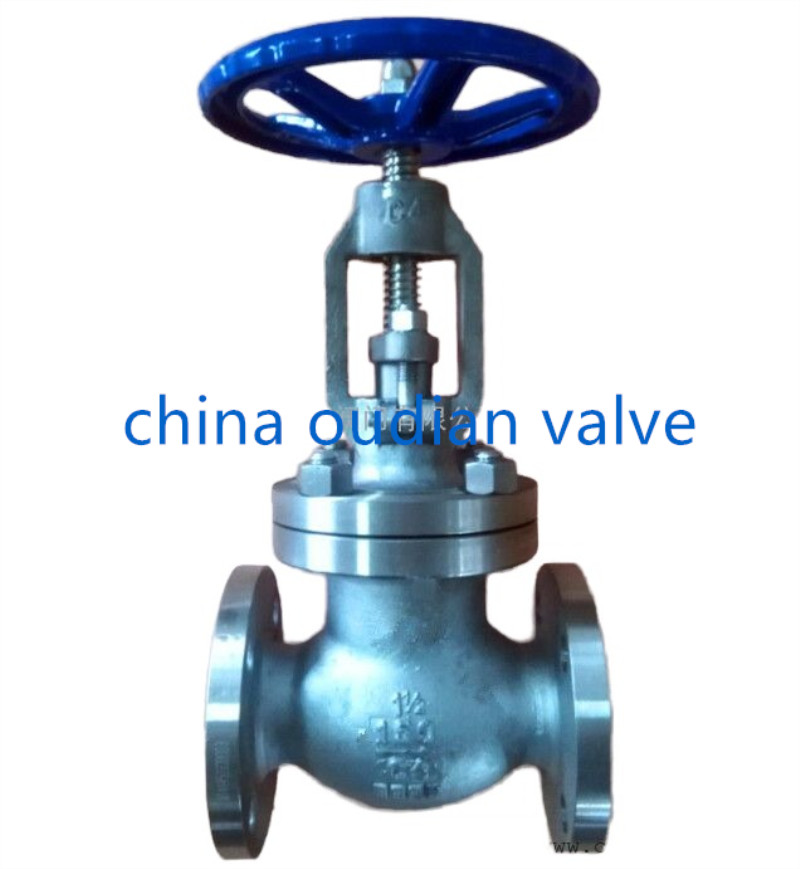
C4 Globe Valves,API600,150LB,RF End
China C4 Globe Valve Supplier ,China C4 Globe Valve Manufacture,150LB C4 Globe Valve ,RF End C4 Globe Valve.
- Product: 150LB C4 Globe Valve
- Pressure Class: ANSI 150LB (≈2.0 MPa)
- Nominal Size: 4 inch (DN100)
- Type: Globe Valve — linear motion valve for regulating, throttling, or shutting off flow, good for precise control.
Key Specifications
- Design Standard: ASME B16.34, API 6D, BS 1873
- Face-to-Face: ASME B16.10
- Connection: Flanged (ASME B16.5 RF) or threaded
- Matériau du corps: Common — WCB carbon steel, CF8/CF8M stainless steel, bronze, cast iron
- Trim: Stainless steel, Stellite hard-faced
- Plage de température: -29°C ~ +425°C (carbon steel); -40°C ~ +200°C (stainless steel)
- Test Pressure: Shell — 3.0 MPa; Seat — 2.2 MPa (per API 598)
- Opération: Handwheel (standard), gearbox, pneumatic/electric actuator available
Applications
- Used in pipelines for water, steam, oil, gas, and general chemicals
- Suitable for systems requiring frequent regulation or tight shutoff
- Common in oil & gas, power plants, chemical, and process industries
C4 steel globe valve (00Cr14Ni14Si4) is an ideal type of high silicon ultra-low carbon nitric acid resistant stainless steel, especially suitable for use in concentrated nitric acid media, and also resistant to corrosion from various concentrated nitric acid and sulfuric acid mixed acids
Once the valve disc of the C4 steel globe valve is moved away from the closed position, there is no longer contact between its valve seat and the sealing surface of the valve disc. Therefore, the mechanical wear of its sealing surface is very small, and its sealing performance is very good. The disadvantage is that particles in the flowing medium may be trapped between the sealing surfaces. However, if the valve disc is made into steel balls or ceramic balls, this problem can be solved with toughness.
The valve seat and disc of C4 steel globe valve are relatively easy to repair or replace, and there is no need to disassemble the entire valve from the pipeline when repairing or replacing the sealing element. This is very suitable for situations where the valve and pipeline are welded together.
C4 steel globe valve has the following advantages:
There is no knife edge corrosion after welding, and it has good resistance to small hole corrosion and excellent resistance to stress corrosion;
C4 steel has good plasticity and toughness, which increases safety and reliability, and avoids the danger of industrial pure titanium igniting and exploding in nitric acid;
C4 steel has much better corrosion resistance than high-purity aluminum, and has mechanical properties that high silicon cast iron cannot match. Its welded joints have mechanical properties and corrosion resistance comparable to the base material.
The use of C4 steel in pipelines, valves, condensers, pumps, and other equipment for the indirect method (magnesium nitrate method) of concentrated nitric acid is very effective.
The material of C4 steel globe valve is 00Cr14Ni14Si4 ultra-low carbon austenitic stainless steel, which has excellent resistance to intergranular and stress corrosion cracking
FAQ: C4 Globe Valve
Material & Core Properties
A:
- Alloy C4 = UNS N06455 / Werkstoff Nr. 2.4610
- Composition: Ni balance, Mo 14–16%, Cr 14–18%, Fe ≤3%, Si ≤0.08%, C ≤0.01%
- Compared to C‑276: Much lower carbon, silicon and iron → significantly improved thermal stability, much less risk of intermetallic precipitation (sigma phase) during welding or heat exposure; better resistance to intergranular corrosion; almost identical corrosion resistance in service, but far better fabricability and long‑term reliability.
- It is a solid‑solution strengthened nickel alloy, fully austenitic, non‑magnetic.
A:✅ Universal resistance to both reducing AND oxidizing acids and mixtures — one of the few alloys stable in both environments
✅ Excellent resistance to hydrochloric acid (all concentrations, all temperatures up to boiling) — this is its #1 strength
✅ Resistant to sulfuric, phosphoric, hydrofluoric, nitric, and mixed acids
✅ Resists chloride pitting, crevice corrosion and stress corrosion cracking completely
✅ Stable in wet chlorine, chlorine dioxide, hypochlorite, brines, and strong oxidizing salts
✅ Superior to C‑276, 904L, 2507, Alloy 20 in hot hydrochloric acid and mixed acid systems
A:
- Temperature range: ‑196°C ~ +450°C continuous; short‑term up to 500°C
→ Above 450°C, slight risk of precipitation; C‑276 better above 500°C
- Pressure class: 150LB – 2500LB / PN16 – PN160
- Mechanical properties: Tensile ≥690 MPa, Yield ≥280 MPa — high strength, good for high‑pressure service
Alloy Best For C4 Comparison 904L Dilute sulfuric / organic acids ❌ Far worse in HCl, mixed acids, oxidizers Alloy 20 Sulfuric acid ❌ Not suitable for HCl / oxidizing mixes 2507 Seawater / high chloride ❌ Fails rapidly in reducing acids / HCl C‑276 Extreme high‑temp / complex media ⚠️ Similar corrosion resistance; C4 better thermal stability & weldability C4 Hydrochloric acid, mixed acids, oxidizing + reducing combinations, wet chlorine ✅ Best choice here Q5: What media is C4 NOT recommended for?A:❌ Fuming nitric acid or very strong oxidizers at high temperature (use C‑276 / 625 instead)
❌ Molten alkalis or high‑temperature halide salts above 500°C
❌ Cost‑sensitive general service (too expensive — use 316L / 904L)
Design & Specification — 150LB C4 Globe Valve
Q6: What are the standard codes and specifications?A:
- Design: ASME B16.34, API 6D, BS 1873, ISO 10434
- Pressure Class: 150LB (2.0 MPa) — also available 300LB, 600LB
- Face‑to‑Face: ASME B16.10
- Flange Ends: ASME B16.5 RF / RTJ
- Material Spec: ASTM B574 (bar), B564 (forging), B472 (casting)
- Test & Inspection: API 598, ISO 5208 — leakage rate A (zero leakage optional)
Q7: What is the standard model and construction?A:
- Model: J41W‑150LB‑C4 (straight‑through flanged globe valve)
- Bonnet: Bolted bonnet (BB) standard; pressure‑seal bonnet for ≥Class 600
- Stem: Outside Screw & Yoke (OS&Y), fully exposed, easy maintenance
- Body: Cast or forged Alloy C4
- Trim: Alloy C4 (solid) or Stellite 6 hardfaced (standard trim #5)
- Seal: Metal‑to‑metal; soft seal (PTFE/FFKM) available ≤ 200°C
- Connection: Flanged RF (Class 150) is most common; butt‑weld optional
Q8: What is the recommended bill of material (BOM)?
Part Matériel Note Body / Bonnet Alloy C4 (UNS N06455) Cast A494 N‑40M or forged B564 Disc / Stem / Seat Alloy C4 Solid or hardfaced Gasket Alloy C4 spiral wound + graphite ❌ Do NOT use 316L gasket Packing Expanded graphite / PTFE / Kalrez® High‑purity grade Fasteners Alloy C‑276 / Alloy 625 / Alloy C4 ❌ Carbon steel strictly forbidden — severe galvanic corrosion Bushing Alloy 625 / C4 Anti‑galling properties Q9: Why is Class 150 the most popular for C4 globe valves?A:
- Most severe corrosion processes operate at low‑to‑medium pressure (< 2 MPa)
- Class 150 is lighter, more economical, easier to install and maintain
- Alloy C4 has high strength — Class 150 provides large safety margin
- Standard flange dimensions and gasket availability
✅ Selection & Application
Q10: When must I choose C4 Globe Valve instead of other alloys?A: Choose C4 if your service is:✅ Hydrochloric acid — any concentration, any temperature, including boiling
✅ Mixed acids (e.g. H₂SO₄ + HCl, HNO₃ + HF) — where single alloys fail
✅ Wet chlorine, chlorine dioxide, bleaching solutions, hypochlorite
✅ Hot brines, chloride‑containing oxidizing media
✅ Processes requiring frequent throttling / regulation in above environments
✅ Best application rule:If 904L / Alloy 20 / 2507 fail or are unstable → select C4
Q11: Is globe valve the right design for Alloy C4?A: YES — perfect match.
- Globe valve = best design for throttling, precise control, frequent adjustment
- Alloy C4 = most corrosion‑resistant material for these severe media
- Together = ultimate control solution for aggressive chemical processes
- Gate/ball valves are NOT suitable here due to poor control and higher wear in corrosive service
Q12: Which industries use 150LB C4 globe valves?A:
- ✅ Chlor‑alkali industry: Brine electrolysis, wet chlorine, hypochlorite
- ✅ Pharma & Fine Chemicals: Hydrochloric acid reactions, chlorination processes
- ✅ Pulp & Paper: Bleach plants, chlorine dioxide generation
- ✅ Pickling & Metal Treatment: Mixed acids, hydrochloric acid regeneration
- ✅ Agrochemicals: Herbicide/pesticide synthesis, chlorination
- ✅ Waste Treatment: Acid neutralization, flue gas scrubbing with mixed acids
🔧 Installation & Operation
Q13: What are the critical installation rules?A:
- Flow direction: Always install with flow under the disc (arrow on body) — standard globe valve practice
- Galvanic isolation: ABSOLUTELY NEVER connect directly to carbon steel. Use insulating gaskets, C4/Alloy 20 spool pieces or PTFE sleeves. C4 is a noble alloy; any contact with iron/steel will cause rapid corrosion of the steel and contamination.
- Welding: Use matching filler ERNiCrMo‑43 / W.Nr. 2.4610; low heat input; NO post‑weld heat treatment needed — this is where C4 is better than C‑276
- Contamination control: Keep away from carbon steel tools, wire brushes or grinding dust — iron contamination causes surface rust and reduces corrosion resistance
- Torque: Tighten bolts evenly in cross‑pattern; C4 has lower thermal expansion than austenitic steels — check retorque after heat‑up
Q14: Can it be used for throttling and frequent operation?A: YES — this is its primary purpose.
- Excellent stability under high differential pressure
- Good resistance to erosion and cavitation
- For severe service ΔP > 20 bar → specify anti‑cavitation / multi‑stage trim
- Operable 10,000+ cycles without degradation
Q15: Is C4 galling‑prone? How to handle?A: Like all nickel alloys, C4 has tendency to gall under metal‑to‑metal sliding.✅ Solution: Use high‑purity graphite packing, smooth stem finish, and anti‑seize compound compatible with nickel alloys; avoid dry operation.
🧹 Maintenance & Troubleshooting
Q16: What is the expected service life?A:
- Hydrochloric acid service: 8–15 years
- Mixed acids / oxidizing reducing mixtures: 6–12 years
- Far longer than 904L, Alloy 20 or duplex; near‑perfect stability in proper conditions
Q17: Why is there leakage after some time?A:
- ✅ Most common cause: Wrong gasket material (316L instead of C4) → corrosion of gasket → leakage
- ✅ Second cause: Improper installation / uneven bolt load
- ✅ Third: Solid particles trapped on seat → lapping required
- ✅ True corrosion leakage is extremely rare if material is correctly selected
Q18: Can I repair or reweld a C4 globe valve?A: YES — very repairable.
- Weld repair: Use ERNiCrMo‑43; no heat treatment required (big advantage over C‑276)
- Seats/discs can be re‑lapped or re‑hardfaced with Stellite
- Stem can be re‑machined or coated
- No loss of corrosion resistance after repair — unique benefit of C4
Q19: Brown stains or discoloration — is it corrosion?A: Almost always NOT corrosion.
- C4 does not corrode in correct service
- Stains = surface oxide film or iron contamination
✅ Clean with nitric acid passivation or pickling paste — surface will restore to bright finish
Q20: When to replace instead of repair?A: Only if:
- Wall thickness reduced below minimum by severe erosion
- Severe mechanical damage or crack
- Application changed to media outside C4 capability
⚖️ Comparison & Selection Summary
Q21: C4 vs C‑276 — which to pick?A:
- ✅ Choose C4: Hydrochloric acid, mixed acids, wet chlorine, welded fabrication required, temperature < 450°C — better stability, easier welding, same corrosion resistance
- ✅ Choose C‑276: Higher temperature > 450°C, fuming nitric acid, very complex mixed halides — better high‑temperature strength
Q22: C4 vs Hastelloy B3?A:
- B3: Best for pure reducing acids (HCl, H₂SO₄) — fails in oxidizing conditions
- C4: Stable in BOTH reducing AND oxidizing — universal choice
→ If oxidizing species present (air, Fe³⁺, Cu²⁺, chlorine) → C4 only
✅ Final Recommendation:150LB C4 Globe Valve is the standard solution for low‑pressure severe corrosion service where hydrochloric acid, mixed acids or wet chlorine are present — unmatched performance, excelle