


Wie das zweiteilige 2000 WOG Kugelventil aus Kohlenstoffstahl die Konkurrenz übertrifft 🇺🇸
Wie das zweiteilige 2000 WOG Kugelventil aus Kohlenstoffstahl die Konkurrenz übertrifft 🇺🇸
In the competitive landscape of industrial valving, selecting the right component can significantly impact operational efficiency, safety, and cost. While various valve types and materials exist, the 2-Piece 2000 WOG Carbon Steel Ball Valve frequently stands out as a superior choice for a specific range of demanding applications. This analysis will explore how its unique combination of features allows it to outperform many common competitors.
1. Robustness & Pressure Handling: Outperforming Gate and Globe Valves
- Gate Valves: While excellent for full on/off service with minimal pressure drop, gate valves are not designed for throttling and can suffer from seat wear if partially open. Their operation is also slower than a ball valve. In high-pressure applications like a 2000 WOG system, the quick, positive shut-off and robust seating of a ball valve offer greater reliability and less chance of leakage compared to the wedge-and-seat mechanism of a gate valve.
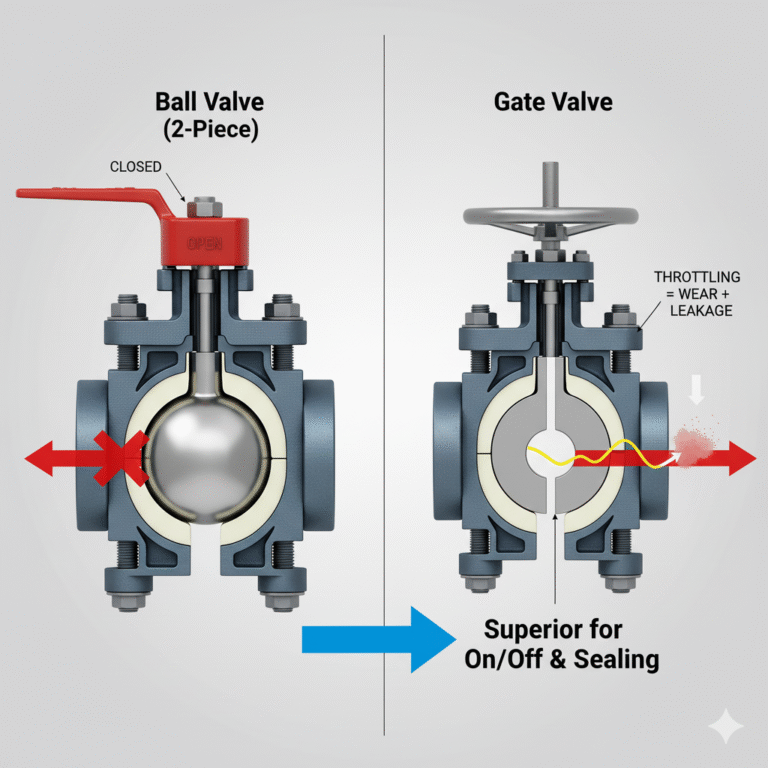
ball valve vs gate valve - Globe Valves: Globe valves excel at throttling and flow regulation, but they introduce a significant pressure drop due to their tortuous flow path. For applications requiring full, unobstructed flow and quick on/off functionality—which is typical for a 2000 WOG rating in pipelines or process lines—the ball valve’s straight-through flow path and quarter-turn operation make it far more efficient. Its robust construction also allows it to maintain a tight seal under high pressures more effectively in on/off service than a globe valve might.
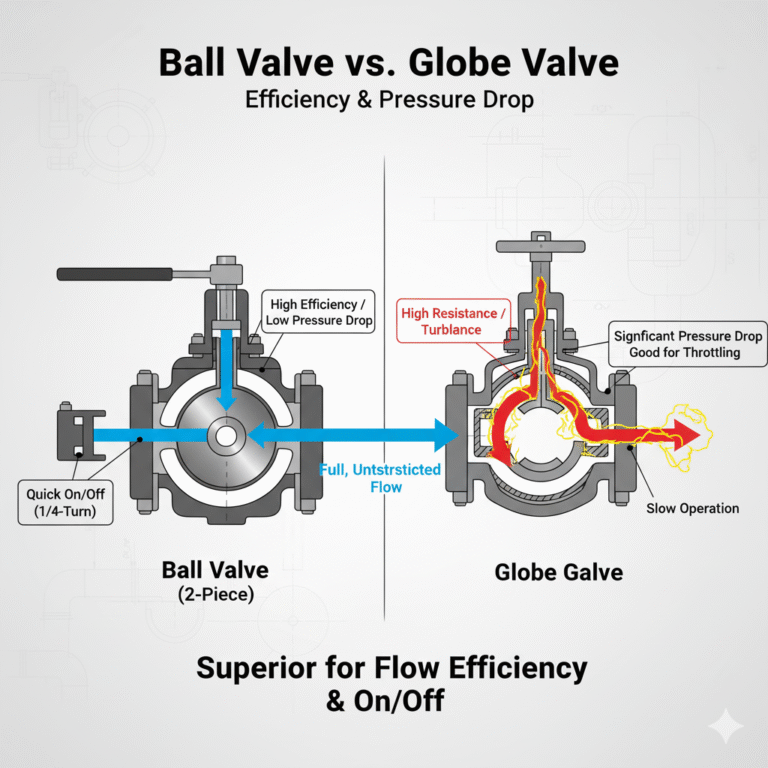
ball valve vs globe valve
2. Material Advantage: Carbon Steel vs. Bronze/Cast Iron
- Bronze Valves: While common for water services at lower pressures, bronze valves typically cannot match the 2000 WOG pressure rating of their carbon steel counterparts. Carbon steel offers significantly higher tensile strength and resistance to mechanical stress, making it the clear choice for high-pressure oil, gas, and petrochemical applications where bronze would be inadequate.
- Cast Iron Valves: Cast iron provides good strength for many applications but is generally brittle and less ductile than carbon steel. It’s less suitable for high-pressure systems (like 2000 WOG) where thermal shock or external stresses might occur. Carbon steel’s superior impact resistance and ductility make it a much safer and more reliable option in demanding industrial environments.
3. Design Superiority: 2-Piece vs. 1-Piece Ball Valves
- Maintainability and Repair: The 2-piece design allows for easier disassembly and access to the valve’s internal components (ball, seats, stem packing). This is a significant advantage over 1-piece (or single-body) ball valves, which are often considered “throwaway” valves once the seats wear out. For industrial applications, the ability to repair and maintain a valve extends its lifespan and reduces total cost of ownership, especially for a valve rated for 2000 psi.
- Sealing Integrity: In a 2-piece design, the two body sections are bolted together, allowing for more robust construction and better sealing integrity under high pressure compared to some 1-piece designs which might rely more heavily on threading or a less substantial body joint.
4. Cost-Effectiveness vs. Stainless Steel
- Strategic Material Choice: While stainless steel offers superior corrosion resistance, it comes at a higher cost. For applications dealing with non-corrosive fluids (like many oils, gases, and refined fuels) or in environments where external corrosion is managed, carbon steel provides the necessary strength and pressure rating without the added expense of stainless steel. The 2-piece 2000 WOG carbon steel ball valve perfectly balances performance and budget for these specific use cases, offering robust performance where stainless steel’s additional corrosion resistance would be overkill.
Abschluss
The 2-piece 2000 WOG carbon steel ball valve is not just another valve; it’s a meticulously engineered solution that strategically leverages material properties and design advantages. It outperforms competitors by offering:
- Superior on/off control and flow efficiency over gate and globe valves.
- Unmatched strength and pressure handling compared to bronze and cast iron.
- Enhanced maintainability and longevity due to its 2-piece construction.
- Optimal cost-performance ratio for non-corrosive, high-pressure applications where stainless steel is not a strict requirement.
For industries requiring reliable, high-pressure fluid control with an eye on both performance and operational expenditure, the 2-piece 2000 WOG carbon steel ball valve remains a top-tier choice.